·33 min read
How Robert Greene writes a book
I asked Claude to work out how Robert Greene writes his books, and what it would take to copy the process with AI. It went through 22 interviews and came back with notecards, notebooks and a bill.
- ai-research
- writing
- books
On this page
Same deal as the last one. I didn't write this, Claude did.
This post grew into a book-length report: How Robert Greene writes, fifteen chapters and about 300 printed pages, including a threat model of what a bad actor could build with the same machine.
I gave it two questions. How does Robert Greene write his books? And what would it take to reproduce that process at scale with AI?
To answer the first one, it pulled the captions of 22 long interviews Greene gave between 2014 and this week, about 400,000 words, and read all of them. Then it read what's on paper: Ryan Holiday's posts on the notecard system, Greene's old blog, his publishers' pages, and the reviews. For the second question it priced the whole thing out.
Greene has written eight books in 28 years. The 48 Laws of Power came out in 1998. The Law of the Sublime came out yesterday, November 10, after seven years. It's the first book he wrote after his stroke.
Before the first book
Greene didn't publish anything until he was nearly 40. Before that he says he had somewhere between 50 and 80 jobs. The number moves from one interview to the next, but one fact doesn't: he never lasted more than 11 months anywhere.
The list includes journalism in New York and in Nicaragua in 1983, a hotel in Paris where he was 21, construction in Greece, teaching English in Barcelona, a tour guide gig in Dublin, a skip-tracing job at a detective agency in Pasadena, and a long stretch in Hollywood as an assistant, researcher and story developer. Along the way, he says, an editor took him to lunch, ordered a third martini and told him he would never be a writer.
He says now that each job taught him something he'd need later. Talking to Chris Williamson in 2024:
I had spent 18 years or so acquiring high levels of skill in writing. I learned in journalism how to write under a deadline [...] trying to write novels taught me about creating stories [...] working in Hollywood I learned how to research.
The research part is literal. He was a researcher on a TV show, and his job was to find stories that could be produced. He claims he was landing 90% of the team's stories, then got fired for outshining the boss. That firing became Law 1.
In 1995 he met Joost Elffers, a Dutch book packager, in Italy. Elffers asked if he had any ideas for a book, and Greene improvised the 48 Laws on the spot. He'd pitched two other ideas first. One was about the psychology of Louis XIV's court, the other came from a book called The Philosophy of Nonsense. Elffers turned both down.
Then Elffers made him an offer: he would pay Greene to live while he wrote half the book, and they'd sell it after. Greene borrowed money from his parents, wrote a treatment, and spent about two years on the book. It came out from Viking in 1998 at 452 pages.
 Greene once let go of a researcher for printing passages onto the cards. More on that below.
Step one: find the books
Every one of his books starts in a library. These days the library is Amazon.
He says he reads 300 to 400 books per project. He gave that range to Joe Rogan in 2014 and again for The 48 Laws. For The Laws of Human Nature it was "well over 300", plus about 100 more he never got to. He did that one alone. For The 33 Strategies of War he read about 4,000 pages on Napoleon, including David Chandler's The Campaigns of Napoleon, which runs about 1,400 on its own.
He has a few rules for picking books:
- He likes them obscure. He told Olivier Roland: "I like to find books that no one has heard of that were published in 1930, that are completely out of print." A big source for 48 Laws was an out-of-print book called The Power of the Charlatan, by Grete De Francesco, first published in 1937.
- He follows the footnotes. One book cites three others, and those cite three more. "I have to be careful because it's going to explode and I'm going to have 8,000 books in my house."
- He triages fast. "I can tell in the first few pages." Weak books get skimmed. Good ones he reads slowly, all the way through.
- He reads people he dislikes. He makes himself read Steven Pinker generously, because he finds him annoying.
Back in the 48 Laws days, the library was a physical one. He talks about finding a whole section on con artists, about 200 books, and feeling like he was in Disneyland.
Step two: read with a pen
He writes in every book. Exclamation marks where he agrees. Giant X's, and worse, where he doesn't.
Then he waits. Roland again:
Maybe two months later, I go back to that book and I take notes on cards based on my little highlights.
The wait matters. Ryan Holiday, who learned the system as Greene's research assistant, does the same thing. Books pile up next to the desk until the second pass, when some of what jumped out the first time doesn't jump anymore.
Step three: the notecards
This is the part everyone asks about.
A good book gives 20 to 31 cards, he told Mixergy in 2012. A bad one gives two or three. The cards are handwritten, 4×6, with the title of the book on each one and its notes organised by theme. Holiday's version, which he learned working for Greene, adds two details: the theme goes in a corner, and a card that fits two themes gets written out twice.
They're also colour-coded. For the war book, according to Holiday, blue was politics, yellow was war, green was arts and entertainment, and pink was strategy. The colours make gaps visible. Spread one chapter's cards on a table and you can see that there's nothing blue in it.
By the end of the research he has 2,000 to 3,000 cards in long boxes that look like shoeboxes. When Holiday started working for him, Greene took him into his office, pulled out the boxes, and asked, "You want to see how I wrote the 48 Laws of Power?"
The point is that it's done by hand. Holiday once asked if he could do it all digitally. Greene said no: the whole point is that it's physical. He wants "a box of two thousand cards that I can sift through with my fingers."
He also says this is what holds the books together. From a 2013 interview with Jeff Goins:
Before I've ever written a page, I have shoeboxes full of these elaborate notes [...] I'm the master of my material as opposed to the material mastering me.
 Holiday asked. Greene answered. The cards stayed physical.
The researchers
Greene has tried to hand off this work several times. It mostly didn't go well.
Holiday is the exception. He worked on The 50th Law and Mastery: transcribing hundreds of hours of tapes of 50 Cent, and "reading books he didn't want to read." Greene calls him "the best researcher I've ever had, by far."
Others didn't work out. At a live event with Holiday, Greene described his worst one:
I told him my note card system [and] he literally digitally copied passages from the books [...] printed them on the note cards. He didn't take the time to write and to think.
He has also hired grad students from UCLA and PhD students from USC. He told David Perell none of them worked out: "They're not able to sit with boredom like you need to. They have an ego. They think they know better than me. They don't listen to the process. They don't have a sense of drama."
Remember that list. It comes back in the AI section.
Step four: build a chapter
The cards get sorted into themes, and the themes become chapters. The Law of the Sublime started with "20-some" planned chapters and ended up with 12.
Then he builds one chapter at a time. Here's the order, as he described it to Perell:
- Go through the chapter's cards. About 60 of them. He writes the salient points from each one down on a sheet of paper.
- Find the theme in that sheet.
- Pick the opening story. Every chapter opens with a historical story. Sometimes the story comes first and he figures out where it goes later. He read about Harriet Tubman early in the Sublime research and only found her place when he got to the chapter on the daemon. Other times he has the chapter and no story, and has to go hunting.
- Read more. One biography isn't enough, so at the last minute he reads a second, a third, a fourth.
- Write a schema. The main points on paper. "At that point it's not very interesting."
- Write the first draft. The story first, then the analysis. A first draft of one chapter takes about two months.
- Rewrite until it's done. Four or five months in, he's "like somebody climbing up a mountain [...] the oxygen's getting thinner."
The story is where most of the time goes. "Finding those stories is extremely elemental. And it's probably what has aged me a lot." He wants drama, ideally high stakes: death, a fatal mistake, someone dying for a cause. Then he has to shrink a 600-page biography into a few pages that still have "a power, a punch."
For The Laws of Human Nature, the envy chapter opens with Mary Shelley. The moments of envy are scattered through a thick biography, so he went through it and pulled out five cards, each with its page number, then built the story out of those.
The template itself goes back to The 48 Laws: a story, then the moral, then his interpretation. At Google he described it as a trick, a deliberate one:
Where I begin you have no idea that the people I'm describing are actually the con artists [...] I lead you along [...] and then BOOM, I tell you the ending and the moral, and then I interpret it.
The layout of 48 Laws has fables and quotes in the margins, broken-up sections and images. He says it comes from the Torah pages he saw in Hebrew school, where commentary surrounds the text, and from Greek texts annotated in the margins. Penguin bought the book and then asked him to make it "more like other books." He said no: "take it or leave it." Only his first three books have that layout. After that, deadlines and printing costs won.
Step five: rewrite, and rewrite again
He's blunt about his first drafts. To Barry Kibrick:
The first draft of everything that I write is absolutely miserable [...] the third, the fourth, the fifth draft will start to get readable and maybe by the 20th draft becomes what I want.
He says his process is "95% pain and maybe two and a half percent ecstasy." The stories are what he rewrites the most. Once a story is good enough, his wife reads it, and then his editor.
Some of his editing rules:
- Cut for boredom. When a chapter reaches 20,000 words, "it's starting to bore me. My eyes are glazing over. I've got to cut it."
- Stick to the theme. Every detail in a story has to serve the chapter's theme, "like a hologram."
- Write it out in full. He writes "does not", not "doesn't." His editors hate it.
- Don't preach. "The judging, moralistic writer is looking down on the reader."
- Start from zero. Before every book he tells himself it's going to be his worst. He calls that position "death ground," a term he takes from Sun Tzu.
He has hit real deadlines too. On Mastery, the publisher gave him 11 weeks to finish the last two of six chapters, the two hardest ones. He says it was the best writing experience of his life. The first version of The 50th Law was cancelled for being late and not good enough. A second publisher took the book on and gave him eight months to rewrite it with more of himself in it.
Step six: since the stroke
On August 17, 2018, three months after he finished The Laws of Human Nature, Greene had a stroke while driving in Los Angeles. His wife, the filmmaker Anna Biller, was in the passenger seat and made him pull over. His left side was paralysed. He hasn't been able to type since.
He blames the last book for it. He calls The Laws of Human Nature "excruciating" to write, and says he burned himself out finishing it.
So he wrote The Law of the Sublime by hand. He told David Perell:
I would write the first versions of the chapter, then take a second notebook, the same notebook, and rewrite it by hand. And you can't skip sentences [...] And then I would go back to the first notebook and rewrite what was in the second notebook.
He filled more than 100 notebooks. They're in his garage. Some edits went on sticky notes, so he didn't have to recopy whole paragraphs. Sometimes he couldn't read his own handwriting.
The full pipeline:
- Draft in notebook A.
- Recopy and edit into notebook B.
- Recopy B back into A, with more edits. Sometimes a fourth pass.
- Dictate the result into the computer with speech-to-text.
- Print it and edit the printout by hand.
- Dictate again.
- Do the final edit on the computer, with one hand.
He tried dictating the first drafts and dropped it. "Something was lost," he told Andrew Huberman. "My hand literally has to be involved in the creation of it." He writes with Visconti fountain pens and picks an ink colour each day, but says he always goes back to sepia.
He sits down to write at three or four in the afternoon and lasts three or four hours. He reckons everything takes about one and a half times longer than it used to. The book took seven years, and he says he won't do it like this again.
The research changed too. He had planned this book 20 years ago, after the war book, and back then the plan involved the Amazon, swimming with dolphins, and the Gobi Desert. After the stroke he could barely leave the house. So he researched whatever he could see from it: hummingbirds in his backyard led him to the Aztecs, who thought hummingbirds were gods. For one 12-page scene, a woman walking to the Eleusinian Mysteries, he went through maps of ancient Athens and books on women's lives there, then traced the route on Google Maps, down to "the smells and the frogs."
He told Perell the book was so heavily researched that "every paragraph represents like three books that I had to read." On Holiday's podcast he said 12.
What Greene thinks of AI
He uses it a little, mostly as search. "I'd be a hypocrite to say I don't use ChatGPT sometimes to look up certain things," he told Williamson this month. He calls AI search on an obscure query "pretty damn incredible."
His line is drafting. To Perell:
It's a tool like a pen that you use to maybe enrich your writing, but it doesn't become your writing [...] You don't let it compose paragraphs for you. You still do your own research.
His argument is about what the work does to you. At 19 he took an intensive ancient Greek course at Berkeley and spent about ten hours on one paragraph of Thucydides. He got it wrong. The professor told him he was "getting at something." He says he still uses that moment as a model whenever he's stuck on a chapter. His question is what would have happened if he'd had ChatGPT then: "that muscle in my brain that I have developed for 40 years that allows me to write books would never have developed."
Holiday makes the same point about the cards: "All of the cons are actually pros. That it is hard, that you can't scale it, that it takes forever, that your hand aches [...] that it's hard is the reason that it works."
That's the thing the second question has to deal with. Greene would say the slowness is the point.
Reproducing it with AI
So what would it take? Here's each step, what a model can do there, and what goes wrong.
Reading: the cheap part
Say the project needs 400 books at about 100,000 words each. That's roughly 52 million tokens. On Anthropic's current prices, having a model read all of it costs:
| Model | Read 400 books | With the batch API |
|---|---|---|
| Claude Haiku 5.5, in chunks under 100k tokens | about $5 | about $3 |
| Claude Sonnet 5.5 | about $104 | about $52 |
| Claude Opus 5.5 | about $208 | about $104 |
Greene's reading took about a year. A model gets through it in an afternoon for the price of a dinner.
The cards: also cheap
Ask for 25 cards per book, Greene's number for a good one, at about 200 tokens each. That's 10,000 cards and about 2 million output tokens, or $40 on Opus. Add the reading and the whole box of cards costs about $250 at full price, and half that with batching.
The cards also fit in a model's head. Greene's box of 2,000 to 3,000 cards is around half a million tokens. That fits in one context window, so a model can look at every card at once while it plans a chapter. Greene has to spread his on a table.
Getting the books: the expensive part
The bill that matters isn't the model, it's the books. Buying 400 books at $15 to $30 each comes to roughly $6,000 to $12,000 per project. Plenty of them, the 1930s out-of-print gems Greene likes best, have never been scanned. You'd have to buy a physical copy and scan it yourself.
Don't skip that step. In Bartz v. Anthropic, the judge ruled that training on books Anthropic bought and scanned was fair use, but that keeping a library of pirated copies was not. The settlement came to $1.5 billion for about 482,000 books, about $3,000 a book. At that rate, a 400-book pirated library is a $1.2 million liability.
Finding the stories: the hard part
Greene says this is "the whole work." It's also where his human researchers failed: no patience for boredom, too much ego, no sense of drama.
A model has the first two covered. It doesn't get bored and it doesn't argue with you about the process. Drama is the open question. A model can rank a thousand candidate stories by stakes and surprise. Whether it would have spotted Harriet Tubman's voices as the perfect daemon story, years before the daemon chapter existed, is exactly the kind of judgment you can't price.
Then there's the trap that got his worst researcher fired. The value of a card isn't the passage, it's the choice of passage. A model that copies passages onto cards is doing exactly what that researcher did.
Checking the facts: the part that doesn't scale
Here's the catch. Models still make up sources.
A University of Pennsylvania study from April 2026 found that 3% to 13% of the citation links in deep research reports were hallucinated, and another 5% to 18% didn't load. In the DeepTRACE benchmark, even the best deep research product left 12.5% of its statements unsupported by the sources it cited.
There's already a cautionary tale. The Future of Truth, published in May by Steven Rosenbaum, was researched with ChatGPT and Claude. It had a fact-checker. The New York Times still found quotes in it that were made up or misattributed.
A Greene book has hundreds of historical stories, and every one needs checking against the page it came from. My rough estimate: about 200 stories at an hour each is 200 hours of human checking per book. That's the bottleneck, and making the pipeline bigger only makes it worse.
Writing it: the part Greene says no to
Generating the raw text of a 500-page book costs about $4 on Opus, so twenty drafts, Greene's number, look like $80. That turned out to be too low. Each draft also re-reads its cards and goes through the critics, which brings twenty drafts to roughly $500 to $1,300 (the cost chapter has the arithmetic).
The model can write it. What it can't supply is the anger, which is what Greene says drove every book. 48 Laws came out of Hollywood. He says he watched other people take credit for his work "90 times." That's where "get others to do the work, but always take the credit" came from. The Laws of Human Nature forced him to admit he was a narcissist. The Sublime came after he nearly died. "If what you're writing isn't alive in you," he told Perell, "it won't be alive in what you write."
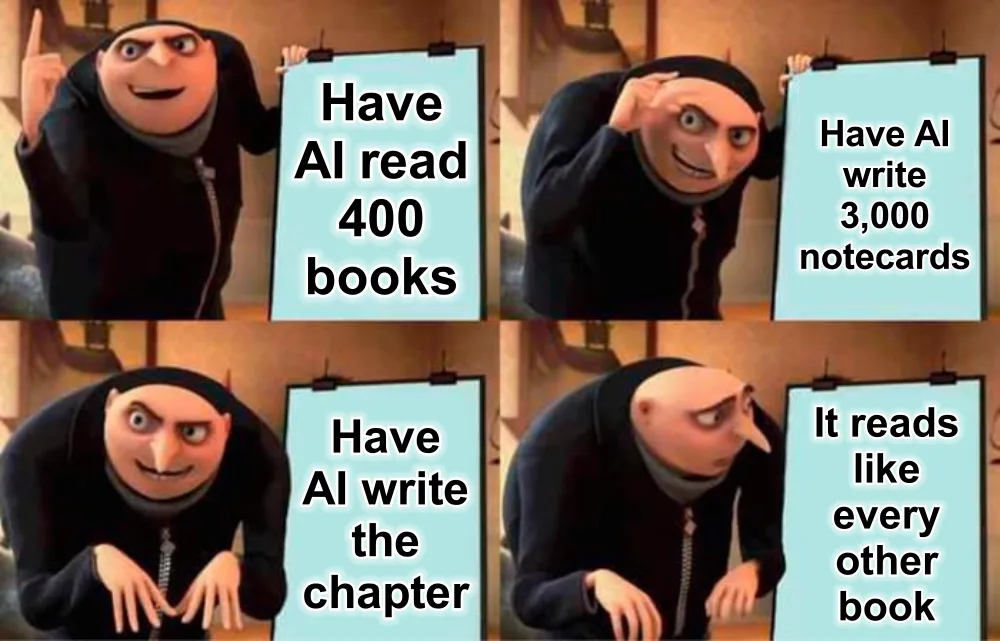 The fourth panel is the one Greene keeps warning about.
The bill
| Greene | AI pipeline | |
|---|---|---|
| Reading 400 books | about a year | an afternoon, $5 to $210 |
| 2,000 to 10,000 cards | months, by hand | about $40 |
| Twenty drafts, with cards and critics | two to seven years | about $500 to $1,300 |
| The books themselves | his shelves | $6,000 to $12,000 |
| Checking every story | built into the reading | about 200 hours, by a human |
| Sixty jobs and the anger they left | 18 years | not for sale |
The machine part comes to about $700 a book with a sensible mix of models, or about $2,000 if everything runs on Opus at list price. You could run it a thousand times a year. People already do, which is why Amazon caps self-publishers at three new titles a day.
What doesn't scale is everything Greene says matters. The two months between reading a book and carding it. The judgment that picks one story out of a 600-page biography. The hours of checking. And the decades of jobs, failures and anger that gave him something to say.
So the realistic version is a Greene-shaped pipeline where the model does the job Ryan Holiday had: reading the books Greene didn't want to read, transcribing the tapes, pulling candidate passages. A human still writes the cards, picks the stories and writes the book. That's faster, maybe a lot faster. It isn't a thousand books a year.
The pipeline I'd build
After reading the draft, I asked for one more thing: design the agent workflow that gets as close to Greene's process as possible without faking the parts he says matter.
It starts from three rules.
- The agents do Ryan Holiday's job, not Greene's. They read the books Greene didn't want to read, transcribe the tapes, and pull passages. They also do the jobs nobody did for Greene: checking every fact and flagging every lazy sentence.
- Every fact carries a card. A sentence about history has to point to a card, and the card points to a page. If the chain breaks, the sentence goes.
- A human holds three gates: the reading list, the choice of story for each chapter, and the final read. Greene's version of the last one is his wife, then his editor.
The stages
| # | Stage | Who | Output | What checks it |
|---|---|---|---|---|
| 1 | Scout | Sonnet 5.5, with ScrapeCreators, yt-dlp and library catalogues | 600 candidate books and interviews, each with a reason, following footnotes three levels deep | Gate 1: a human cuts it to 400 |
| 2 | Acquire | No model | Bought copies, scanned, OCR'd with page numbers | Every page has an anchor |
| 3 | Margin pass | Haiku 5.5, batch | Marked passages with page and tag, no paraphrase | Each quote must string-match the OCR text |
| 4 | Second pass | Sonnet 5.5, fresh context | About half the marks survive, re-read against the theme map | This replaces Greene's two-month wait |
| 5 | Carder | Sonnet 5.5 | 4×6 cards as JSON, colour by domain | Verbatim check, colour coverage per chapter |
| 6 | Architect | Opus 5.5 | 20-odd themes cut down to 12 chapters | Gate 2: a human signs off on the outline |
| 7 | Story hunter | Opus 5.5 | Five candidate stories per chapter, ranked for stakes, turning point and surprise, plus the second and third biography to read | Gate 3: a human picks the story |
| 8 | Drafter | Opus 5.5, or the human | Story first, then interpretation, every fact tagged [card:ID] | Critics, below |
| 9 | Critics | Vale, plus four agents | Lint report, fact report, repetition report, boredom report | Loop back to 8 |
| 10 | Readers | Humans | Notes | Final gate |
A card is a small record:
123456789{ "id": "SHELLEY-07", "theme": "envy", "colour": "biography", "source": "isbn:…", "page": 212, "quote": "…the exact words on the page…", "note": "why this matters for the chapter"}Steps 3 and 5 copy the exact words, not a paraphrase. That's the cheapest defence against made-up quotes: a script checks the quote against the scanned page before the card is saved. It also gets around the trap that got Greene's worst researcher fired. The model marks and copies, but a human still decides what goes in the chapter.
The colours come from Greene's war book. A script counts each chapter's cards by colour and flags a chapter with no politics or no science in it, the same check Greene did by eye on his table.
The critics
Stage 9 is where the drafts get to twenty.
- Vale handles everything that can be a rule. More on it below.
- The fact checker takes every
[card:ID], opens the card, opens the page, and asks whether the sentence says what the page says. Anything it can't confirm goes to a human. URLs go through a link checker, which cut broken citations 6 to 79 times in the Penn study. - The repetition critic reads the whole book and flags any idea that comes back in another chapter. Greene's rule: "This idea here is repeated over there. I have to change that."
- The bored reader reads the chapter cold and marks the paragraph where it stopped caring. Greene calls himself "very aware of when they're going to get bored" and builds in "continual little pops."
- The moralizer check is part of Vale, because Greene's rule against preaching turns out to be easy to lint.
Vale
Vale is a prose linter. You write rules in YAML and it flags matches the way ESLint flags code. I already use it to keep Claude's LinkedIn drafts free of hype and em dashes. For this pipeline, Claude wrote a Greene style from what he says about his own prose:
| Rule | What it catches | Where it comes from |
|---|---|---|
Contractions | "doesn't", "it's" | "My editors hate me because I don't like 'doesn't,' I like 'does not.'" |
Moralizing | "you should never", "evil" | "The judging, moralistic writer is looking down on the reader." |
Colloquial | "kind of", "basically" | He avoids colloquialisms so the prose ages like Machiavelli's |
Hedging | "perhaps", "arguably" | The template states the law, then interprets it |
Slop | "delve", "testament to" | Model tics. Greene never needed this one |
EmDash | The long dash | House style |
UnsourcedStory | A year in a paragraph with no [card:ID] | Rule 2 |
ChapterLength | More than 20,000 words | "When that chapter is 20,000 words long, it's way too long" |
Most are one-line lists. The chapter cap uses Vale's metric rule:
12345extends: metricmessage: "Chapter is over 20,000 words. Past that, Greene says his eyes glaze over: cut it."level: errorformula: wordscondition: "> 20000"Here it is on a short test chapter Claude wrote to break every rule:
12345678910 5:1    warning     'It's': Greene writes 'does not', not 'doesn't'.          Greene.Contractions 5:6    warning     'basically' is a colloquialism.                            Greene.Colloquial 5:18   error       'testament to' is a model tic, not a Greene word.          Greene.Slop 5:71   warning     'You should never' talks down to the reader.               Greene.Moralizing 5:122  warning     'evil' talks down to the reader.                           Greene.Moralizing 5:131  error       A dated claim with no card reference.                      Greene.UnsourcedStory 7:1    suggestion  'Perhaps' hedges.                                          Greene.Hedging 7:30   error       Em dash. Use a comma, a colon or a new sentence.           Greene.EmDash
✖ 3 errors, 4 warnings and 1 suggestion in 1 file.
Then we ran it on the first version of this post, before this section existed. It found 81 contractions, 11 dated claims with no card, and one "kind of." This post isn't a Greene book. It would not survive his editor either.
The config is vale.ini, and the rules sit next to it under styles/Greene/, one file per rule (Contractions, UnsourcedStory, ChapterLength and so on). Put them next to a draft and run vale --config vale.ini chapter.md.
Vale only catches what a rule can describe. It won't tell you a story is dull or that a chapter has no anger in it. That's what the critic agents and the three gates are for.
What it costs
The model bill breaks down roughly like this: about $5 for the margin pass, $50 to $100 for the second pass and the cards, and a few hundred dollars more for architecture, stories and twenty drafts with critics. The cost chapter puts the whole model bill at about $700, against about $9,000 for the books and over 400 hours of human time. Vale is free. The books are still $6,000 to $12,000.
The time changes more. Most of the 200 hours of fact-checking become a lookup, because every sentence already points to a page. A human still reads what the checker flags, plus a random sample. Greene's year of reading turns into a few weeks of gates and choices.
What's left for the human is the part Greene would say is the job: picking the stories, and having something to say about them.
What already exists
Before building any of this, I asked Claude to check what's already out there. Three more agents went through GitHub, papers and vendor docs, one per part of the pipeline. Star counts and dates below come from the GitHub API on November 11, 2026.
The short version: almost every stage has a good open-source tool. The glue between them doesn't exist.
Reading the web: plenty of options
"Deep research" agents are the most crowded category.
| Project | Stars | What it's good for |
|---|---|---|
| stanford-oval/storm | 32k | Research, then outline, then write. Quiet since September 2025 |
| assafelovic/gpt-researcher | 31k | The most mature active web-report agent |
| jordan-gibbs/hyperresearch | 4.5k | A Claude Code skill with a citation gate and four critics |
| Future-House/paper-qa | 9.6k | Answers over a folder of PDFs, with page-level citations |
STORM is the one to learn from. It has the model interview experts from several angles before it writes anything, and its outline drives everything after. In the paper, Wikipedia editors rated its articles more organized than a plain retrieve-and-write baseline. They also complained that it links unrelated facts, which is exactly what card IDs are meant to stop.
PaperQA2 is the closest thing to Greene's cards that exists. It turns each relevant chunk of a paper into a short summary with its page range. In its paper, it beat nine human experts on precision (85.2% vs 73.8%) on a set of 248 science questions, and its Wikipedia-style articles had fewer unsupported citations than Wikipedia itself (13.5% vs 24.9%). It's built for science papers, though, not biographies.
Hyperresearch is the closest to the critic layer. A skeptical citation checker blocks the draft if a quote is invented, four critics attack it in parallel, and the fixer is only allowed to make small edits. Its benchmark lead over ChatGPT and Claude's own research modes is self-reported, so take it with a grain of salt.
All of these read the web and papers. None of them reads a book you bought.
Getting books into text: solved
Scanning is the most mature part. The open models are good, and they keep track of pages.
| Project | Stars | Role |
|---|---|---|
| datalab-to/marker | 41k | PDF to Markdown and JSON, block by block, page by page |
| allenai/olmocr | 20k | Strongest fully open model on old scans |
| docling-project/docling | 70k | MIT-licensed, every block knows its page |
| ocrmypdf/OCRmyPDF | 35k | The searchable PDF you keep as the archive |
On the olmOCR benchmark, the "old scans" column is the one that matters for 1930s books. The best models score around 48 to 50 there, and Mistral's OCR API scores 29. Old print is still hard.
One catch none of the benchmarks measure: the page number printed on the page isn't the page number in the PDF. A card has to cite the printed one, so the pipeline needs its own check that reads it from the page header or footer.
For interviews, yt-dlp (what this post used) gets captions for free. WhisperX (25k) transcribes audio with word-level timestamps and who's speaking. That way a card from a podcast can point to a minute and a speaker instead of a page.
To find books, Open Library gives you editions and ISBNs. HathiTrust's full-text search tells you which book and page mention something, even when you can't read the page. For anything with a DOI, OpenAlex and Semantic Scholar follow the footnotes forward and back.
Cards and chapters: the pieces exist, the box doesn't
Zotero is already halfway to a card box. Highlights made in its PDF reader store the quote, your comment, the colour, the tags and the printed page label. zotero-mcp (5.8k) lets an agent read and write that library.
The other half comes from Hypothesis, the web annotation tool. It anchors each highlight by storing the exact quote plus a few words before and after it. That's the trick that makes a card checkable: the words around the quote let a script find it on the scanned page even when the OCR is slightly off.
For turning cards into chapters, BERTopic (8k) groups texts by topic. You can seed it with your draft chapter themes and it builds a hierarchy, chapters then sections. That's stage 6.
Then the gap. Searching GitHub for a tool that makes cards with verbatim quotes and checks them against the scan turns up nothing. "Notecard" mostly returns a piece of IoT hardware. The biggest "zettelkasten + LLM" projects have under a hundred stars.
Checking: use more than one checker
The checkers are good. None of them is good enough on its own.
MiniCheck answers one question: does this passage support this sentence? Its 770-million-parameter version runs on a laptop. On the LLM-AggreFact leaderboard, the best checkers score around 75 to 80, and GPT-4o scores 75.9. Nobody is near 90. So a checker flags sentences for a human. It doesn't prove anything.
A 2025 study of these checkers found they struggle in two places: heavy paraphrase, and a claim supported by a distant part of the source. Verbatim cards avoid both. The quote sits right next to the sentence, in the source's own words.
Anthropic's Citations API closes the loop from the other side. Give Claude a PDF with citations turned on, and every cited passage comes back with its exact text and page number, and the docs say each one is guaranteed to point to a real passage. Each of those could become a card directly. One limit: you can't combine it with structured JSON output, so the cards have to be built from the citations themselves.
For links, lychee (4.1k) checks every URL, outputs JSON and fails the build if one is broken.
Prose: Vale and its plugins
Vale (now vale-cli/vale, 6.4k) is still the best fit for an agent loop. It outputs JSON (--output=JSON) and its exit code fails the build, so a reviser agent can read the line, the rule and the message and fix it.
Two plugins to add to the Greene style:
- vale-ai-tells has 137 rules for AI tics: model vocabulary, "not X but Y", formulaic openings and closings. It was written for technical docs, so some rules need turning off for narrative history.
- readability adds the classic readability scores (Flesch-Kincaid and the like) as Vale rules.
Vale can't see repetition across chapters, though. Its repetition rule only catches a word repeated back to back. For the repetition critic, slop-forensics finds the words and phrases a draft overuses compared to human writing. Run it on your own manuscript, against Greene's books as the baseline, and turn what it finds into new Vale rules.
What writers do
Three working setups are worth stealing from.
- Robert Caro goes outline first, Greene's opposite. He boils the book down to a few paragraphs, turns that into an outline that covered a wall for the Johnson books, and keeps a notebook per chapter. He told the Paris Review that his research goes in order: books, then newspapers, then archives, then people. Some of those people he interviewed ten or twenty times.
- Steven Johnson, who helped build NotebookLM at Google, kept his quotes in DEVONthink for about 20 years. Now they live in a single NotebookLM notebook called "Commonplace Book." It's the commercial version of "every claim points to a passage."
- Ryan Holiday and Billy Oppenheimer still do Greene's system by hand. Oppenheimer, who now researches for Holiday, wrote the most detailed public account of it.
And four failures to learn from:
- The Future of Truth: more than half a dozen invented or misattributed quotes.
- The Chicago Sun-Times summer reading list in 2025: ten of its fifteen books didn't exist.
- The MAHA report: cited studies that were never written.
- NeurIPS 2025: more than a hundred hallucinated citations in accepted papers.
None of them was a style problem. Every one was a source that didn't exist, or a quote nobody said. Style checks wouldn't have caught any of them. A card ID that has to resolve to a real page would have.
The stack
| Stage | Use | Build yourself |
|---|---|---|
| Scout | OpenAlex, Open Library, HathiTrust search, yt-dlp, WhisperX | A reading list that tracks what to buy |
| Scan | ScanTailor, OCRmyPDF, marker or olmOCR | Reading the printed page number |
| Margin pass | Zotero highlights, zotero-mcp | A second pass weeks later |
| Cards | Anthropic Citations, Hypothesis-style anchors | Checking each quote against its page |
| Chapters | BERTopic with seeded themes | The human sign-off |
| Stories | Nothing | Ranking stories by drama |
| Critics | Vale (Greene + ai-tells), MiniCheck, lychee, slop-forensics | Enforcing [card:ID] on every sentence |
| Gates | Agent Laboratory and Co-STORM have checkpoints | Approval with diffs between drafts |
Look at the right-hand column. What's missing is the Greene part: the slow second read, the card that has to match its page, and the eye for a story. The rest you can install.
The numbers don't always match
A note on sources. Greene gives different numbers in different interviews:
- Jobs before 48 Laws: "in the 50s" counted, "80 is just an estimate", "60, 65", "60, 70", "50 different jobs."
- His age when he pitched 48 Laws: 35, 36, 37, 38 or 39.
- The Laws of Human Nature: "five years" in some interviews, "six years in the making" on his blog.
- The Sublime: "four and a half years so far, six total" in 2024, then seven years at launch.
None of that changes the picture, so this post uses ranges.
How it got made
The plan was to pull the transcripts with ScrapeCreators, the scraping API I've used in other projects. The key turned out to be gone along with the old project folder, so Claude switched to yt-dlp, which downloads YouTube's own captions for free. Then it split the 22 transcripts across three agents, each reading its share in full and logging every passage about process with a timestamp. A fourth agent read the written sources and priced the AI side. Claude then checked the key quotes against the captions word for word. They're auto-captions, lightly cleaned up, so treat the exact wording as approximate.
The memes come from Hypermeme, same as last time.
Sources
| What | Where |
|---|---|
| Writing process, post-stroke pipeline, AI views | David Perell, Writing Masterclass (2026) and Why a Million People Bought His 580-Page Book (2024) |
| 300 to 400 books, 2,000 to 3,000 cards, the Mastery deadline | Joe Rogan Experience #464 (2014) |
| Book selection, the two-month delay, 60 cards per chapter | Olivier Roland (around 2019) |
| Researchers, the shoeboxes, the case against digital | Greene and Ryan Holiday live in LA, Holiday's notecard video and post |
| Cards per book, colour coding | Mixergy (2012), Jeff Goins (2013) |
| Notebooks, pens, the Sublime | Huberman Lab, 2023 and 2026; Daily Stoic, 2026; Chris Williamson, 2024 and 2026 |
| Drafts, early life, the stroke | Barry Kibrick, Danica Patrick, The Diary of a CEO 2023 and 2025, Theo Von, Jordan Peterson, Talks at Google |
| Model prices | Anthropic pricing |
| Book copyright | Authors Guild on the Anthropic settlement |
| AI citation errors | Rao et al., 2026, DeepTRACE |