Daily Philosophy Brands Beyond Stoicism: 21 Untapped Traditions
Ryan Holiday turned Stoicism into a media empire. The Daily Stoic has 320,000+ email subscribers, millions of books sold, a merch store with medallion coins, leather journals, courses, a membership community, and a live event series. The formula is clear: take an ancient philosophy, make it accessible, package it into daily content, and build physical products around the core ideas.
Here's the thing: Stoicism is one tradition among dozens. And most of them have zero competition in the "daily philosophy brand" space. The market has been educated by Holiday's success. People now understand that ancient wisdom can be packaged into modern media. They're hungry for more.
This paper analyzes 21 philosophical, esoteric, and fringe traditions that could each support a brand as large as (or larger than) the Daily Stoic. Some are ancient. Some are bleeding edge. All of them have zero serious competition in the daily brand space. For each one, I'll cover the core ideas, the brand concept, the content strategy, the product line, the target audience, and why now is the right moment.
1. 1. Platonism: "The Daily Form"
Core Ideas
Plato believed the physical world is a shadow of a deeper reality. His famous Allegory of the Cave: imagine prisoners chained in a cave, watching shadows on a wall, thinking that's all there is. One prisoner escapes, sees the sun, and realizes the shadows were just projections of real objects. That's Plato's whole thing. The "Forms" (or "Ideas") are the true reality: perfect, eternal, unchanging. The chair you sit in is just a rough copy of the Form of "Chair."
This extends to everything: justice, beauty, truth, goodness. There's an ideal version of each, and our job is to use reason to get closer to understanding them. Plato also believed the soul is immortal, that learning is really "remembering" (anamnesis), and that philosophers should govern because they're the ones who've escaped the cave.
Key Thinkers and Texts
- Plato: The Republic, Symposium, Phaedo, Phaedrus, Timaeus
- Plotinus: The Enneads (Neoplatonism)
- Proclus, Iamblichus (late Neoplatonists)
- Raphael's The School of Athens (visual icon of the tradition)
Brand Concept: "The Daily Form"
Tagline: "See beyond the shadows." The brand identity draws on classical Greek aesthetics: white marble, gold accents, deep blue backgrounds (the color of the sky outside the cave). The logo could be a geometric solid (Plato was obsessed with geometry; "Let no one ignorant of geometry enter" was inscribed above his Academy).

Content Format
- Daily email: one Platonic concept per day, connected to modern life. "Today's Form" could explore ideal friendship, ideal work, ideal courage.
- Podcast: "Outside the Cave" conversations about seeing past surface appearances.
- YouTube: animated explainers of the dialogues. Plato wrote in dialogue form, which is inherently dramatic and visual.
Merch and Products
- Geometric solid desk sculptures (the five Platonic solids: tetrahedron, cube, octahedron, dodecahedron, icosahedron)
- A "Cave & Light" candle set: one dark, one bright
- Gold foil prints of Platonic quotes on deep blue backgrounds
- A premium journal with "What is the Form of ___?" prompts
Target Audience
Intellectually curious professionals aged 25 to 45 who love ideas for their own sake. People who read The Atlantic, listen to long podcasts, and think about what "the good life" actually means. Also: design lovers attracted to the clean geometry of the brand.
Why Now
We live in a world of shadows: social media projections, AI generated content, deepfakes. Plato's core insight (most of what you see is not real) has never been more relevant. The "post truth" era is basically the Cave. A brand that helps people distinguish reality from illusion has enormous cultural resonance right now.
Sample Daily Reflection
April 12: The Geometry of Friendship
In the Lysis, Socrates asks a deceptively simple question: what makes someone your friend? Is it because they're useful to you? Because they're pleasant? Or is there something deeper?
Plato suggests real friendship is two people drawn together by their shared love of the Good. Not networking. Not mutual benefit. Two souls recognizing something true in each other.
Today, look at your closest relationships. Are they built on convenience, or on something that would survive if the convenience disappeared?
2. 2. Epicureanism: "The Garden Letter"
Core Ideas
Epicurus gets a bad rap. People think Epicureanism means "eat fancy food and drink expensive wine." It's basically the opposite. Epicurus taught that pleasure is the highest good, but defined pleasure as the absence of pain (ataraxia: tranquility of mind, and aponia: absence of bodily pain). The greatest pleasures are simple: friendship, bread, water, a quiet garden, good conversation.
He also taught that the gods don't care about us (so stop worrying about divine punishment), that death is nothing (when you're alive death isn't here; when death is here you're not), and that most of what people chase (wealth, fame, power) actually produces more anxiety than pleasure.
Key Thinkers and Texts
- Epicurus: Letter to Menoeceus, Principal Doctrines, Vatican Sayings
- Lucretius: De Rerum Natura (On the Nature of Things)
- The Garden of Epicurus in Athens (a physical school, not just a metaphor)
Brand Concept: "The Garden Letter"
Tagline: "Enough is already here." The aesthetic draws on Roman garden frescos, terracotta tones, olive greens, warm earth colors. Think: the Villa of Livia garden paintings. Lush but simple. Natural but curated.

Content Format
- Daily email: "Today's Garden" reflections on simple pleasures and anxiety reduction.
- A "Pleasure Audit" weekly newsletter: what actually brought you joy this week vs. what you thought would?
- Podcast: interviews with people who downsized, simplified, or opted out of the rat race.
Merch and Products
- Herb garden starter kits branded with Epicurean quotes
- Simple ceramic cups (the Epicurean drinking vessel: clay, not gold)
- A "Garden Journal" for tracking daily pleasures
- Linen tote bags with "Enough is already here"
- Artisan bread kits (Epicurus literally said bread and water are sufficient for happiness)
Target Audience
Burned out professionals, minimalism enthusiasts, the "simple living" community on Reddit and TikTok. People who've realized the hedonic treadmill is real. Also: the "cottagecore" aesthetic crowd, the slow living movement, anti hustle culture.
Why Now
Burnout is an epidemic. "Quiet quitting" and "soft living" are cultural movements. People are actively searching for philosophies that validate rest, simplicity, and genuine pleasure over achievement. Epicureanism is the ancient version of what millions are already groping toward. The only thing missing is a brand that gives it a name and a daily practice.
Sample Daily Reflection
April 12: The Bread Test
Epicurus wrote: "Send me a pot of cheese, so that I may have a feast when I choose." That's it. That was his idea of luxury. A pot of cheese.
We've been trained to think joy requires something expensive, rare, or Instagram worthy. But think about the last time you felt genuinely content. Was it at a Michelin star restaurant? Or was it something smaller: a good coffee, a warm blanket, a friend who made you laugh?
Today's practice: notice one simple pleasure that costs nothing. Sit with it. That's the Garden.
3. 3. Cynicism: "The Daily Cynic"
Core Ideas
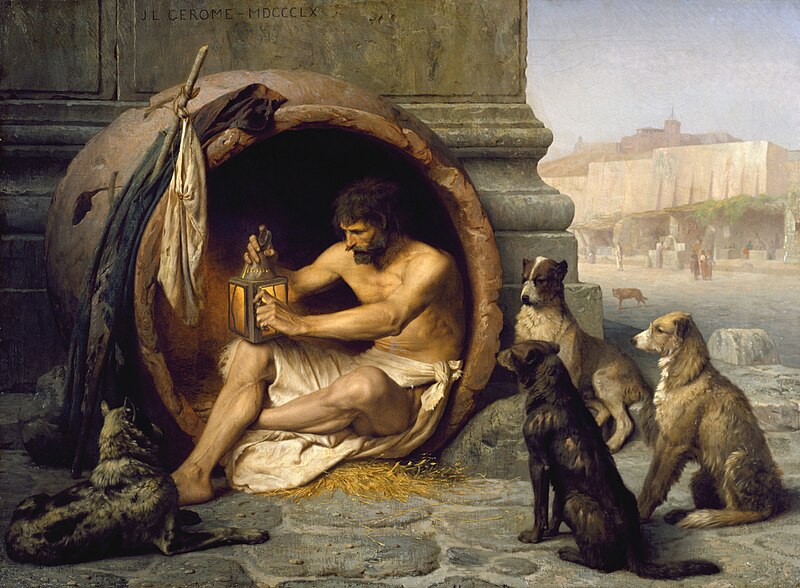
Diogenes of Sinope lived in a large ceramic jar in the marketplace. He carried a lantern in broad daylight, claiming to be "looking for an honest man." When Alexander the Great visited him and offered to grant any wish, Diogenes said: "Yes, stop blocking my sunlight." The Cynics believed that virtue is the only good, that social conventions are mostly nonsense, and that you should live according to nature with radical honesty and zero pretension.
The word "cynic" comes from the Greek for "dog" (kynikos): the Cynics were called dogs because they lived shamelessly in public, ate simply, and barked truth at anyone who'd listen. Cynicism was the punk rock of ancient philosophy.
Key Thinkers and Texts
- Diogenes of Sinope (most quotes survive through anecdotes in Diogenes Laërtius)
- Antisthenes (Socrates' student, proto Cynic)
- Crates of Thebes and Hipparchia (the Cynic power couple)
- Jean Léon Gérôme's 1860 painting of Diogenes in his barrel
Brand Concept: "The Daily Cynic"
Tagline: "Cut the noise." Raw, stripped down aesthetic. Black and white with a single accent color (amber, like lantern light). The logo: a lit lantern. The voice is irreverent, funny, and brutally honest. This brand has edge.
Content Format
- Daily email: short, punchy, confrontational. "What social convention did you follow today without questioning it?"
- Social media: savage but wise one liners. Think @naval meets ancient Greek stand up comedy.
- Podcast: "The Honest Man" interviews where guests have to drop all pretense.
- TikTok/Reels: modern Diogenes scenarios. "What would Diogenes say about [current trend]?"
Merch and Products
- A brass lantern keychain
- Plain, unbranded clothing (the ultimate Cynic flex: no logos)
- A "Barrel Collection" of minimalist ceramic mugs
- Stickers and patches with Diogenes quotes
- A deck of "Uncomfortable Truth" cards for dinner parties
Target Audience
The anti establishment crowd. People who follow accounts like @BullshitJobs, who read Fight Club at 19 and never fully recovered. Gen Z and millennials who are allergic to corporate speak. Also: comedians, writers, and anyone who values honesty over politeness.
Why Now
We're drowning in performative everything: performative productivity, performative wellness, performative activism. The Cynics were the original bullshit detectors. In an age of personal branding and LinkedIn cringe, a philosophy that says "just be real and stop caring what people think" is going to hit hard. Also: Diogenes is already a meme icon. The brand awareness is built in.
Sample Daily Reflection
April 12: The Lantern Check
Diogenes walked through Athens with a lit lantern at noon. "I'm looking for an honest person," he said.
You don't need a lantern. Just scroll through your own social media. How much of what you posted this week was real? How much was performance?
The Cynics didn't hate people. They hated fakeness. And they thought most suffering comes from pretending to be something you're not.
Today: say one true thing you've been holding back. Just one. See what happens.
4. 4. Confucianism: "The Daily Rite"
Core Ideas
Confucius (Kong Qiu, 551 to 479 BCE) taught that society works when people fulfill their roles with sincerity and care. The core concepts: ren (benevolence/humaneness), li (ritual propriety), xiao (filial piety), and junzi (the exemplary person). Confucius believed small daily rituals (how you greet someone, how you eat, how you treat your parents) are what hold civilization together.
This isn't about blind obedience. It's about the idea that good character is built through practice, the same way a musician gets better through daily scales. You become good by doing good things, over and over, until they're second nature. The "Six Arts" every educated person should master: rites, music, archery, chariot driving, calligraphy, and mathematics.
Key Thinkers and Texts
- Confucius: The Analects (Lunyu)
- Mencius: Mengzi (human nature is good)
- Xunzi (human nature needs cultivation)
- Zhu Xi (Neo Confucianism, Song dynasty synthesis)
- The Great Learning, The Doctrine of the Mean
Brand Concept: "The Daily Rite"
Tagline: "Small acts, deep roots." The aesthetic is inspired by Chinese ink painting and calligraphy: clean brushstrokes, bamboo imagery, off white backgrounds, ink black text. Elegant and deliberate. Every design element feels intentional.

Content Format
- Daily email: "Today's Rite" focuses on one small practice to do with more care (a conversation, a meal, a greeting).
- Calligraphy prompts: weekly quotes from the Analects to hand copy. Confucians believed the act of writing itself was cultivation.
- Podcast: "The Exemplary Person" interviews about craftsmanship, mastery, and doing ordinary things extraordinarily well.
Merch and Products
- Calligraphy brush sets with a practice guide
- Bamboo desk organizers (bamboo symbolizes the scholar's resilience in Confucian art)
- Tea ceremony starter kits (tea is central to Confucian social ritual)
- A "Daily Rite" practice journal with morning and evening reflection spaces
- Ink stone paperweights with engraved maxims
Target Audience
People interested in habit formation, self improvement through practice, Asian philosophy, and craftsmanship culture. Also: the "atomic habits" crowd who wants a deeper philosophical foundation for their routines. Parents thinking about how to raise their kids with strong values.
Why Now
The "habit" market is enormous (Atomic Habits sold 15+ million copies) but it's all mechanics, no meaning. Confucianism provides the "why" behind daily practice. Also: Chinese philosophy is massively underrepresented in Western media brands, despite huge interest. The first mover who packages Confucian wisdom accessibly for a Western audience has a wide open field.
Sample Daily Reflection
April 12: The Greeting
Confucius taught that how you greet someone reveals your character. Not what you say. How you say it. The attentiveness in your eyes. Whether you really see the person in front of you.
The Analects 1.6: "A young person at home should be filial, and abroad, respectful to elders. They should be earnest and truthful. They should overflow in love to all, and cultivate the friendship of the good."
Today, greet one person with your full attention. Put the phone down. Look at them. Mean it.
5. 5. Taoism: "The Dao Daily"
Core Ideas
The Dao (or Tao) is the way: the fundamental principle underlying everything. But here's the catch: "The Dao that can be spoken is not the true Dao" (first line of the Dao De Jing). It's not something you can define or grasp. You have to flow with it.
Wu wei (non action, or effortless action) is the central practice. It doesn't mean doing nothing. It means not forcing things. Like water: it doesn't fight the rock, it flows around it, and eventually the rock is worn smooth. The yin yang symbol captures the constant interplay of opposites: light/dark, active/passive, hard/soft. Each contains the seed of the other.
Key Thinkers and Texts
- Lao Tzu: Dao De Jing (Tao Te Ching)
- Zhuangzi: Zhuangzi (the butterfly dream, the useless tree)
- Liezi: Liezi
- The tradition of shan shui (mountain water) landscape painting
Brand Concept: "The Dao Daily"
Tagline: "Flow, don't force." The aesthetic is Chinese ink wash painting: misty mountains, still water, empty space. Lots of whitespace. Muted tones: ink black, fog grey, jade green. The design itself should feel like wu wei: effortless, uncluttered, breathing.

Content Format
- Daily email: very short. Sometimes just a single line from the Dao De Jing with a one paragraph commentary. The format itself embodies wu wei: less is more.
- Ambient audio: "Dao moments" 2 minute guided meditations with nature sounds.
- Social media: nature photography + Taoist one liners. This would dominate Instagram aesthetics.
Merch and Products
- Ink wash art prints of landscapes
- A "Water Stone" desk object (smooth river stone, a tactile reminder to flow)
- Loose leaf tea collections curated around Taoist themes
- Incense sets with a minimalist ceramic holder
- A beautifully designed pocket edition of the Dao De Jing
Target Audience
The mindfulness and meditation crowd who want something beyond generic "wellness." Professionals struggling with burnout and control issues. Nature lovers. Minimalist design enthusiasts. Also: the enormous market of people who already have yin yang tattoos but have never read the Dao De Jing.
Why Now
Taoism is the perfect antidote to productivity culture. The core message (stop forcing, start flowing) is exactly what a generation of burned out knowledge workers needs to hear. The aesthetic (ink wash, minimalism, nature) is already popular in design. And the Dao De Jing is one of the most translated books in history: the audience already exists. It just needs a daily practice built around it.
Sample Daily Reflection
April 12: The Empty Bowl
Dao De Jing, Chapter 11: "We shape clay into a pot, but it is the emptiness inside that holds whatever we want."
Your schedule is full. Your mind is full. Your inbox is full. But usefulness comes from emptiness. A cup is useful because it's empty. A room is useful because it has space.
Today, create one gap. Cancel one thing. Leave one hour open. See what fills it when you stop forcing.
6. 6. Buddhism: "The Middle Way"
Core Ideas
Siddhartha Gautama was a prince who left his palace, tried extreme asceticism, found it didn't work either, and discovered the middle path between luxury and self denial. The Four Noble Truths: life involves suffering (dukkha); suffering comes from craving and attachment; suffering can end; the Eightfold Path is the way to end it.
Mindfulness (sati) means paying attention to the present moment without judgment. It's not about emptying your mind. It's about noticing what's there: thoughts, sensations, emotions, rising and falling like waves. The lotus flower is the central symbol: it grows out of mud but blooms clean above the water.
Key Thinkers and Texts
- The Buddha (Siddhartha Gautama): the Pali Canon, especially the Dhammapada
- Nagarjuna: Mulamadhyamakakarika (emptiness philosophy)
- Thich Nhat Hanh: modern mindfulness teacher
- Shunryu Suzuki: Zen Mind, Beginner's Mind
- The tradition of Zen gardens (karesansui)
Brand Concept: "The Middle Way"
Tagline: "Between grasping and running." The aesthetic draws on Zen minimalism: raked sand patterns, smooth stones, lotus imagery, warm neutrals, soft light. Clean, calm, unhurried. The brand should feel like walking into a Japanese rock garden.

Content Format
- Daily email: a short teaching plus a 2 minute mindfulness prompt. Practical, not preachy.
- App: guided micro meditations (3, 5, 10 minutes). The market here is proven (Headspace, Calm) but nothing connects daily meditation to Buddhist philosophy in an accessible way.
- Podcast: "The Beginner's Mind" conversations about letting go of expertise and seeing things fresh.
Merch and Products
- A desktop zen garden kit (sand, stones, miniature rake)
- Meditation cushions (zafu) in contemporary colors
- Mala bead bracelets with lotus charms
- A "Middle Way" daily journal with gratitude + letting go prompts
- Incense and a lotus shaped holder
Target Audience
The existing meditation/mindfulness market (huge: Headspace has 70+ million downloads) plus people who want the philosophy behind the practice. Also: the wellness community looking for something with more depth than "just breathe."
Why Now
"Mindfulness" has been fully mainstream for a decade, but it's been divorced from its Buddhist roots. Most people who meditate have no idea about the Four Noble Truths or the Eightfold Path. There's a gap: people want to go deeper than apps, but Buddhist texts feel inaccessible. A brand that bridges that gap (daily, practical, rooted in actual Buddhist philosophy) would own an enormous space.
Sample Daily Reflection
April 12: The Second Arrow
The Buddha taught about two arrows. The first arrow is the painful event itself: you lose a client, someone says something hurtful, you make a mistake. That one you can't avoid.
The second arrow is your reaction: the rumination, the self blame, the catastrophizing. That one is optional.
Today, when something stings, notice the first arrow. Then watch for the second one. Can you feel it being drawn? Can you choose not to fire it?
7. 7. Existentialism: "The Free Daily"
Core Ideas
"Existence precedes essence." You weren't born with a purpose. There's no script. You exist first, and then you create your meaning through choices. Sartre called this "radical freedom": you are "condemned to be free." Every moment is a choice, and every choice defines who you are. There's no dodging this. Even choosing not to choose is a choice.
Simone de Beauvoir extended this to gender and ethics: you don't just have freedom, you have a responsibility to fight for others' freedom too. Camus explored the tension between our need for meaning and the universe's refusal to provide it. The existentialists gathered in Parisian cafés (Café de Flore, Les Deux Magots), smoked Gauloises, and debated until dawn. The aesthetic is Left Bank noir.
Key Thinkers and Texts
- Jean Paul Sartre: Being and Nothingness, Existentialism Is a Humanism, Nausea
- Simone de Beauvoir: The Second Sex, The Ethics of Ambiguity
- Albert Camus: The Stranger, The Myth of Sisyphus
- Søren Kierkegaard: Either/Or, Fear and Trembling (the proto existentialist)
- Martin Heidegger: Being and Time
Brand Concept: "The Free Daily"
Tagline: "You choose. Every day." The aesthetic is mid century Parisian: black and white photography, café interiors, cigarette smoke (metaphorical), jazz, rain on cobblestones. Think French New Wave cinema meets newsletter design. High contrast. Moody but alive.

Content Format
- Daily email: a situation or dilemma, then the existentialist take. "You're stuck in a job you hate. Sartre would say..."
- Podcast: "Bad Faith" calls out the ways we avoid confronting our freedom (blaming circumstances, hiding behind roles, "I had no choice").
- Newsletter: weekly "existential audit" prompting readers to examine whether they're living authentically.
Merch and Products
- Café de Flore style espresso cups with quotes
- Black Moleskine style journals ("Write your own essence")
- Vintage style poster prints of Sartre, de Beauvoir, Camus
- A "Radical Freedom" enamel pin
- French roast coffee subscription (leaning into the café culture angle)
Target Audience
Creatives, writers, philosophy students, Francophiles, and anyone going through a quarter or midlife crisis. People who feel trapped and need philosophical permission to choose differently. Also: the enormous "dark academia" aesthetic community on TikTok and Tumblr.
Why Now
The "what am I doing with my life" question has never been louder. Career pivots are normal now. Remote work eliminated the default structure that used to define people. When you can work from anywhere, do anything, be anyone: existentialism's insistence that YOU must choose becomes not abstract philosophy but daily necessity. Plus, the aesthetic sells itself.
Sample Daily Reflection
April 12: Bad Faith at Work
Sartre described "bad faith" (mauvaise foi) as pretending you don't have a choice when you do. The waiter who's a little too perfectly a waiter. The employee who says "I have to" when they mean "I'm choosing to because the alternative scares me."
Today's question: where in your life are you saying "I can't" when the truth is "I won't"? There might be good reasons for your choice. But call it what it is: a choice.
8. 8. Absurdism: "The Daily Sisyphus"
Core Ideas
Camus said: the universe is indifferent, we desperately want meaning, and the collision between those two facts is the Absurd. You have three options: suicide (giving up), religion (a "philosophical leap" into faith), or revolt (accepting the absurdity and living fully anyway). Camus chose revolt.
His central image: Sisyphus, condemned by the gods to push a boulder uphill forever. Every time he reaches the top, it rolls back down. Camus says: "One must imagine Sisyphus happy." Why? Because the struggle itself is enough. The act of pushing, of refusing to quit, of finding joy in the effort even when there's no final victory: that's the absurd hero's triumph.
Key Thinkers and Texts
- Albert Camus: The Myth of Sisyphus, The Stranger, The Plague, The Rebel
- Samuel Beckett: Waiting for Godot
- Franz Kafka: The Trial, The Metamorphosis
- Eugène Ionesco: The Bald Soprano
Brand Concept: "The Daily Sisyphus"
Tagline: "Push anyway." The aesthetic is stark and beautiful: a single boulder, a steep hill, a human figure. Mediterranean colors (Camus was Algerian French): terracotta, sun bleached white, sea blue. The brand has a dark humor that Stoicism lacks. It's existentialism's funnier, more honest cousin.
Content Format
- Daily email: very short. An absurd observation about modern life + a Camus quote + a prompt to find joy in the struggle.
- Social media: absurdist humor meets philosophy. Memes that make you think. This brand should be funnier than any other philosophy brand.
- Podcast: "Happy Sisyphus" conversations about finding meaning in meaningless work, repetitive tasks, and life's built in comedy.
Merch and Products
- A small polished boulder desk weight ("your daily rock")
- Sisyphus themed t shirts with minimalist line art
- "Push Anyway" enamel pins and stickers
- A Camus quote poster series (Mediterranean color palette)
- An absurdist daily desk calendar with one absurd fact per day
Target Audience
Millennials and Gen Z who cope through humor. The "this is fine" dog meme generation. People who know life is absurd and want a philosophy that says "yes, and that's OK." Also: Camus already has massive cultural cachet. He's the "cool" philosopher. The Stranger is the book every college student reads and never forgets.
Why Now
Pandemic, climate anxiety, political chaos, AI taking jobs. The collective feeling right now is: "nothing makes sense anymore." Absurdism doesn't try to make it make sense. It says: correct, it doesn't make sense, and you can still find joy. That message is enormously comforting in 2026. It's Stoicism for people who found Stoicism too serious.
Sample Daily Reflection
April 12: The Rock and the Inbox
You cleared your inbox yesterday. It's full again today. You cleaned the kitchen last night. There are dishes in the sink this morning. You finished one project. Three more appeared.
Sisyphus pushes his boulder up the hill. It rolls back down. He walks back down and pushes again.
Camus says: "The struggle itself toward the heights is enough to fill a man's heart."
Today, don't push the boulder hoping it'll stay at the top. Push it because pushing is the thing. The walk back down is yours. Own it.
9. 9. Ubuntu: "The Daily We"
Core Ideas
Ubuntu is a Southern African philosophy captured in the Zulu/Xhosa phrase "Umuntu ngumuntu ngabantu": a person is a person through other people. Or more simply: "I am because we are." Your identity, your humanity, your value: none of it exists in isolation. You become yourself through your relationships and your community.
This isn't collectivism that erases the individual. It's the insight that individuality itself is a communal creation. Ubuntu ethics say: actions are right when they promote harmony and honor communal relationships. Compassion, dignity, reciprocity, and shared responsibility are the core values. Archbishop Desmond Tutu made Ubuntu famous globally as a framework for reconciliation after apartheid.
Key Thinkers and Texts
- Desmond Tutu: No Future Without Forgiveness
- Nelson Mandela (lived Ubuntu principles in reconciliation politics)
- Mogobe Ramose: African Philosophy Through Ubuntu
- Thaddeus Metz: contemporary Ubuntu ethicist
- Augustine Shutte: Ubuntu: An Ethic for a New South Africa
Brand Concept: "The Daily We"
Tagline: "I am because we are." The aesthetic draws on African art: warm earth tones (ochre, sienna, burnt orange), geometric patterns from textile traditions (kente, shweshwe), community gathering imagery. Bold, warm, inviting. The visual identity should feel like a gathering, not a lecture.
Content Format
- Daily email: stories of communal wisdom, mutual aid, and relational ethics. How does Ubuntu apply to your workplace, your family, your neighborhood?
- Community first: a membership community is the core product, not just an add on. The medium IS the message.
- Podcast: "Through Others" conversations about belonging, reconciliation, and building genuine community in an atomized world.
- Social media: spotlight stories of people practicing Ubuntu in daily life.
Merch and Products
- Collaborative art prints by African artists (revenue shared with the artists; the business model embodies the philosophy)
- A "We" journal with prompts about relationships and community
- Shared meal kits: recipes designed to be cooked and eaten together
- Woven friendship bracelets made by Southern African artisans
- Community gathering guides: how to host meaningful dinners, circles, check ins
Target Audience
People feeling isolated by remote work and digital life. The "loneliness epidemic" crowd. Community builders, social workers, teachers, and activists. Also: the African diaspora looking for connection to philosophical roots. And anyone who felt something was missing from hyper individualist Western self help.
Why Now
Loneliness is now officially a public health crisis (the US Surgeon General said so). The "community" conversation is everywhere. But most community building advice is tactical (how to run a Discord, how to host events). Ubuntu provides the philosophical foundation: why community matters, what it means to be truly connected. Western philosophy is overwhelmingly individualist. Ubuntu offers a fundamentally different starting point. It's fresh, it's needed, and it's commercially untapped in the media brand space.
Sample Daily Reflection
April 12: The Mirror of Others
Ubuntu teaches that you can't fully know yourself alone. Other people are your mirror. Their joy teaches you what you value. Their pain teaches you what you care about. Their growth shows you what's possible.
Western culture says: "find yourself." Ubuntu says: "find yourself through each other."
Today, think about one person who helped you become who you are. Not by teaching you a skill, but by seeing something in you that you couldn't see alone. Have you told them?
10. 10. Vedanta: "The Daily Atman"
Core Ideas
Vedanta (literally "end of the Vedas") is one of the six classical schools of Hindu philosophy, rooted in the Upanishads. The central insight of Advaita (non dual) Vedanta: Brahman (the ultimate reality, the ground of all being) and Atman (your individual soul/self) are one and the same. "Tat tvam asi": thou art that. The separation you feel between yourself and the universe is maya (illusion).
This isn't abstract metaphysics. The practical implication is radical: your deepest self is already complete, already infinite, already at peace. Suffering comes from identifying with the ego (the small self) instead of the Atman (the true self). The path is jnana (knowledge/inquiry), bhakti (devotion), and karma (selfless action).
Key Thinkers and Texts
- The Upanishads (especially Brihadaranyaka, Chandogya, Mandukya)
- Adi Shankara: Vivekachudamani (Crest Jewel of Discrimination), 8th century CE
- Ramana Maharshi: "Who am I?" self inquiry method
- Swami Vivekananda: brought Vedanta to the West at the 1893 Parliament of Religions
- Nisargadatta Maharaj: I Am That
Brand Concept: "The Daily Atman"
Tagline: "Thou art that." The aesthetic draws on Hindu sacred art: deep saffron and burgundy, mandala patterns, lotus motifs, Devanagari script accents. Rich, warm, layered. Not the watered down "yoga studio" aesthetic, but something with genuine depth and cultural richness.
Content Format
- Daily email: one verse from the Upanishads with a modern commentary. Focus on the "Who am I?" inquiry tradition.
- Guided self inquiry: weekly audio sessions using Ramana Maharshi's method.
- Podcast: "That Art Thou" conversations with scholars, monks, and practitioners about non duality in daily life.
- YouTube: visual meditations using mandala art and sacred geometry.
Merch and Products
- Mala beads (108 bead meditation necklaces) in premium materials
- Mandala art prints and coloring books for meditative practice
- Sandalwood and saffron incense sets
- A pocket edition of selected Upanishads
- "Who Am I?" inquiry journal with Ramana Maharshi inspired prompts
Target Audience
The "spiritual but not religious" crowd. People who've done yoga for years and are ready to explore the philosophy behind it. Fans of Alan Watts, Ram Dass, and Eckhart Tolle (all heavily influenced by Vedanta). Also: the Indian diaspora looking for accessible connections to their philosophical heritage.
Why Now
Yoga is a $40+ billion global industry, but almost nobody who does yoga knows anything about Vedanta. That's like going to the gym every day without ever learning about nutrition. The philosophical foundation is just sitting there, waiting to be packaged. The "non duality" and "self inquiry" communities are growing fast on YouTube and podcasts. A structured daily brand would anchor all this scattered interest.
Sample Daily Reflection
April 12: The Wave and the Ocean
A wave rises from the ocean. For a moment, it has a shape, a direction, a name. Then it falls back into the ocean. Was it ever separate?
The Chandogya Upanishad says: "All this is Brahman." Not metaphorically. Literally. The wave IS the ocean, temporarily appearing as a wave.
Today, when you feel small or separate or afraid: remember the wave. You are not a thing apart. You are the whole, wearing a temporary shape. The ocean doesn't worry about one wave.
11. 11. French Enlightenment: "The Daily Salon"
Core Ideas
The French Enlightenment (roughly 1715 to 1789) was the most ambitious intellectual project in history: the belief that reason, science, and free inquiry could improve the human condition. Voltaire fought religious intolerance and censorship. Diderot created the Encyclopédie: an attempt to collect all human knowledge in one work (the original Wikipedia, basically). Rousseau argued that civilization corrupts natural goodness and that political legitimacy comes from the "general will" of the people.
The salon was the institutional form: gatherings in private homes (often hosted by women like Madame Geoffrin and Julie de Lespinasse) where intellectuals debated, argued, and pushed ideas forward. It was the original "ideas festival."
Key Thinkers and Texts
- Voltaire: Candide, Philosophical Dictionary, Letters on the English
- Denis Diderot: Encyclopédie, Rameau's Nephew, the Salons (art criticism)
- Jean Jacques Rousseau: The Social Contract, Emile, Discourse on Inequality
- Montesquieu: The Spirit of the Laws
- Condorcet: Sketch for a Historical Picture of the Progress of the Human Mind
Brand Concept: "The Daily Salon"
Tagline: "Dare to know." (Sapere aude, the Enlightenment motto.) The aesthetic is 18th century French elegance with a modern twist: cream and gold, candlelight, handwritten script fonts, engraved illustration style. Think: the visual language of old Encyclopédie plates (those gorgeous technical illustrations) remixed for a contemporary audience.

Content Format
- Daily email: one Enlightenment idea per day applied to modern problems (free speech, education reform, scientific literacy, reason vs. dogma).
- Weekly "Salon" discussion thread or live audio (Twitter Spaces/Discord stage) where subscribers debate a provocative question.
- Podcast: "Dare to Know" conversations about reason, progress, and the courage to think for yourself.
- A "Modern Encyclopédie" series: deep dives into important topics, written clearly for general audiences.
Merch and Products
- Encyclopédie plate art prints (the original technical illustrations are stunningly beautiful)
- Candlestick holders (the salon aesthetic, literally)
- Voltaire's Candide in a beautiful pocket edition
- Debate card games: Enlightenment era provocations for dinner parties
- Fountain pens and wax seal sets (the writing instruments of the era)
Target Audience
The intellectual dinner party crowd. People who read The Economist, listen to NPR, and believe in progress through reason. Educators. Free speech advocates. History buffs. Also: Francophiles (enormous market) and anyone who misses the idea of genuine intellectual discourse.
Why Now
We're in an epistemic crisis. Misinformation, conspiracy theories, the collapse of shared truth. The Enlightenment's core project (use reason, question authority, value evidence) is under direct attack. A brand that channels that spirit isn't just commercially interesting. It feels culturally necessary. The "intellectual dark web" tried something similar but got captured by politics. A brand rooted in the actual Enlightenment tradition could do it better: intellectually rigorous, politically independent, historically grounded.
Sample Daily Reflection
April 12: Voltaire's Garden
At the end of Candide, after traveling the world and encountering every form of suffering and folly, Candide says: "We must cultivate our garden."
It's not escapism. It's Voltaire's answer to the problem of evil: you can't fix the whole world, but you can make your corner of it better. Through work. Through care. Through doing something concrete instead of philosophizing about everything.
Today, cultivate your garden. What's one real, tangible thing you can make better in your immediate world? Do that. Leave the cosmic questions for tomorrow.
12. 12. Pyrrhonism: "The Daily Doubt"
Core Ideas
Pyrrhonism is the most radical form of skepticism ever developed. The Pyrrhonist doesn't claim "we can't know anything" (that would be a claim). Instead, for every argument, they find an equal and opposing argument, and then suspend judgment (epoché). The result? Ataraxia: peace of mind. Paradoxically, giving up the need to be right about everything is deeply relaxing.
Sextus Empiricus (2nd/3rd century CE) codified this in Outlines of Pyrrhonism. His method: take any belief, show arguments for and against it, demonstrate they're equally balanced, and then let go of the belief. You can still act (you eat when hungry, avoid traffic), but you stop clinging to opinions about things you can't verify. The Pyrrhonist follows appearances, customs, and natural feelings without claiming they're "true."
Key Thinkers and Texts
- Pyrrho of Elis (the founder, left no writings; known through Timon of Phlius)
- Aenesidemus (revived Pyrrhonism in the 1st century BCE)
- Sextus Empiricus: Outlines of Pyrrhonism, Against the Mathematicians
- Michel de Montaigne: Essays (the great modern Pyrrhonist: "Que sais je?" / "What do I know?")
Brand Concept: "The Daily Doubt"
Tagline: "What do you know?" The aesthetic is clean, questioning, slightly unsettling: optical illusions, Escher style impossible geometries, shifting perspectives. The visual identity plays with perception itself. Colors: grey, silver, white, with unexpected pops of color that make you look twice.
Content Format
- Daily email: take one commonly held belief and present the best case for AND against it. Don't resolve it. Let the reader sit with the tension. This is addictive content because people love having their certainties challenged (when it's done respectfully).
- Podcast: "Both Sides and Neither" debates where the hosts genuinely steelman opposing views without picking a winner.
- Social media: "What do you actually know?" provocations. Illusions. Paradoxes. Brain teasers. The most shareable content of any philosophy on this list.
Merch and Products
- Optical illusion art prints
- A "Question Everything" journal with alternating pro/con prompt pages
- Escher inspired desk puzzles
- Montaigne's Essays in a beautiful pocket edition
- "Que sais je?" enamel pins and stickers
- A "Suspension" hourglass (watching sand fall without judgment: very on brand)
Target Audience
Critical thinkers, scientists, journalists, lawyers, and anyone who's tired of everyone being so certain about everything. The "epistemically humble" corner of the internet. People who follow Julia Galef, read SlateStarCodex/Astral Codex Ten, or identify as rationalists. Also: contrarians who enjoy poking holes in arguments (but in a constructive way).
Why Now
Everyone is certain. About everything. All the time. Social media rewards confidence and punishes nuance. Pyrrhonism is the antidote: the philosophy of "I don't know, and that's fine." In an era of polarization and tribal certainty, a brand that teaches people to suspend judgment, hold opposing ideas simultaneously, and find peace in not knowing is wildly countercultural. And countercultural sells.
Sample Daily Reflection
April 12: The Honey Problem
Sextus Empiricus used honey as an example. Honey appears sweet to you. That's how it seems. But IS it sweet? Maybe to someone with a different tongue, it tastes bitter. You experience sweetness. You can't claim sweetness is in the honey itself.
This isn't nihilism. It's humility. You're allowed to enjoy the honey. You just don't need to fight anyone about whether it's objectively sweet.
Today, notice one strong opinion you hold. Can you find one good argument against it? Not to change your mind. Just to loosen your grip a little. Peace lives in that loosening.
13. 13. Tarot and Cartomancy: "The Daily Card"
Core Ideas
Tarot started as a 15th century Italian card game. Somewhere along the way, occultists realized the 78 cards (22 Major Arcana + 56 Minor Arcana) form a complete symbolic map of human experience. The Fool's Journey through the Major Arcana (Fool, Magician, High Priestess, Empress, Emperor, all the way to The World) is a narrative arc of psychological and spiritual development. Each card is an archetype: The Tower is sudden disruption, The Star is hope after collapse, The Hermit is solitary wisdom, Death is transformation (not literal death, almost never literal death).
You don't have to believe tarot "works" in any supernatural sense for it to be useful. The cards function as a randomized prompt system for self reflection. Pull a card, look at the image, read the traditional meaning, and ask yourself: where does this show up in my life right now? It's structured introspection with beautiful art. Carl Jung was fascinated by it. He saw the Major Arcana as a map of the collective unconscious.
Key Thinkers and Texts
- Arthur Edward Waite and Pamela Colman Smith: the Rider Waite Smith deck (1909), the most iconic tarot deck in history
- Alejandro Jodorowsky: The Way of Tarot (tarot as a tool for psychological insight)
- Rachel Pollack: Seventy Eight Degrees of Wisdom (the modern bible of tarot interpretation)
- Carl Jung: wrote extensively about tarot archetypes and synchronicity
- The Thoth Tarot by Aleister Crowley and Lady Frieda Harris (the esoteric maximalist deck)
Brand Concept: "The Daily Card"
Tagline: "What does the card see?" The aesthetic is rich and layered: gold leaf, deep jewel tones (amethyst purple, emerald green, midnight blue), Art Nouveau illustration style. Think Alphonse Mucha meets mystical symbolism. The brand sits at the intersection of art, psychology, and spirituality. It's beautiful enough that even skeptics want the merch.
Content Format
- Daily email: one card pulled each morning. The traditional meaning, a Jungian interpretation, and three reflection questions. "Today's card is The Tower. Where in your life is a structure about to collapse? Is that collapse something to fear, or something to welcome?"
- Weekly deep dive: a single card explored in full depth (history, symbolism, psychology, practical application). 78 cards = 78 weeks of content before you repeat.
- Podcast: "The Spread" conversations about archetypes, symbols, and what the cards reveal about the cultural moment.
- Instagram/TikTok: daily card pulls in beautiful flat lay photography. This content is already wildly popular. The brand just needs to do it better than everyone else.
Merch and Products
- A signature tarot deck with original Art Nouveau inspired art (this alone could be a million dollar product: collector tarot decks sell like crazy)
- Silk tarot cloths and velvet pouches
- Card of the day enamel pins (collect all 78: this creates an insane retention loop)
- A "Daily Card" journal with prompts organized by arcana
- Crystal + card pairing sets (amethyst with The High Priestess, citrine with The Sun)
- Archetype candles (The Moon: jasmine and silver; The Emperor: cedar and amber)
Target Audience
This is enormous. The "WitchTok" community on TikTok has billions of views. Tarot apps have millions of downloads. The spiritual wellness market is projected at $30+ billion. The audience skews female, 18 to 40, but the "psychological tarot" angle (Jungian archetypes, not fortune telling) opens it up much wider. Also: the art collector market. Beautiful tarot decks are coveted objects.
Why Now
Tarot is having a massive mainstream moment. Sales of tarot decks have grown 30%+ year over year since 2020. It's no longer fringe. But the market is fragmented: thousands of indie creators, no dominant daily brand. Nobody has done for tarot what Ryan Holiday did for Stoicism. The person who builds the authoritative, beautifully designed, psychologically grounded daily tarot brand will own a category that's already hungry for leadership. The content practically writes itself: 78 cards, infinite combinations, and a new pull every single day.
Sample Daily Reflection
April 12: The Hanged Man (XII)
A figure hangs upside down from a tree, one leg crossed behind the other. He's not struggling. His face is calm. There's a halo around his head.
The Hanged Man is voluntary surrender. Seeing things from a completely different angle. The pause before the breakthrough. Odin hung from Yggdrasil for nine days to gain the wisdom of the runes. Sometimes you have to stop trying to move forward and just... hang there.
Today's question: what situation have you been trying to force? What would happen if you stopped pushing and just let yourself see it from upside down?
14. 14. Hermeticism: "The Daily Emerald"
Core Ideas
Hermeticism traces back to Hermes Trismegistus ("Thrice Great Hermes"), a legendary figure blending the Greek god Hermes with the Egyptian god Thoth. The core texts, the Corpus Hermeticum, surfaced in Renaissance Florence when Cosimo de' Medici got his hands on a Greek manuscript and told Marsilio Ficino to translate it before Plato. Before Plato. That's how important this was.
The Seven Hermetic Principles (from The Kybalion, a 1908 text claiming ancient Egyptian roots): Mentalism (the universe is mental), Correspondence ("as above, so below"), Vibration (everything moves), Polarity (opposites are identical in nature, just different in degree), Rhythm (everything flows in cycles), Cause and Effect, and Gender (masculine and feminine principles exist in everything). "As above, so below; as below, so above" is probably the most quoted line in all of Western esotericism. It means the macrocosm (the universe) mirrors the microcosm (you). Understanding yourself is understanding the cosmos.
Key Thinkers and Texts
- Hermes Trismegistus: Corpus Hermeticum, The Emerald Tablet
- The Three Initiates: The Kybalion (1908, the accessible gateway text)
- Marsilio Ficino (Renaissance translator who sparked the Hermetic revival)
- Giordano Bruno (burned at the stake in 1600, partly for Hermetic ideas)
- Manly P. Hall: The Secret Teachings of All Ages
Brand Concept: "The Daily Emerald"
Tagline: "As above, so below." The aesthetic is alchemical and Renaissance: emerald green and gold, geometric sacred patterns, old manuscript textures, woodcut illustration style. Think: the Voynich Manuscript meets modern design. Mysterious, beautiful, layered with meaning. Every visual element contains a symbol. The brand rewards close looking.
Content Format
- Daily email: one Hermetic principle applied to everyday life. Monday is Mentalism ("your thoughts shape your reality: here's how"), Tuesday is Correspondence ("what pattern in your outer life reflects something inner?"), and so on through the week.
- A "Great Work" course: Hermeticism frames personal development as alchemy (transforming lead into gold, or base nature into higher nature). A 12 week course mapping the alchemical stages to personal transformation.
- Podcast: "The Emerald Tablet" conversations about hidden patterns, correspondences, and the connections between inner and outer worlds.
- YouTube: visual essays on sacred geometry, alchemical symbolism, and Renaissance Hermeticism. This content does incredibly well on YouTube already. It just needs a flagship brand.
Merch and Products
- Sacred geometry art prints and brass desk sculptures (Metatron's Cube, Flower of Life, Seed of Life)
- An Emerald Tablet replica in actual green stone or resin with gold lettering
- Alchemical symbol jewelry (the seven planetary metals: gold for Sun, silver for Moon, copper for Venus...)
- A "Great Work" journal structured around the alchemical stages (nigredo, albedo, citrinitas, rubedo)
- Incense sets matched to the seven classical planets
- A beautifully designed edition of The Kybalion
Target Audience
The "hidden knowledge" crowd. People who watch YouTube videos about sacred geometry at 2am. Readers of Manly P. Hall and listeners of podcasts about ancient mysteries. Also: the overlap between wellness culture and esoteric spirituality is massive and growing. People who've outgrown basic mindfulness and want something with more intellectual depth and historical weight. The "dark academia" to "esoteric academia" pipeline is real.
Why Now
Esoteric content is exploding online. YouTube channels about alchemy, sacred geometry, and Hermeticism pull millions of views. The Kybalion consistently charts on Amazon. But there's no daily practice brand. Nobody is packaging Hermeticism into the "daily email + merch + community" model that works so well for Stoicism. The aesthetic is killer (emerald and gold, alchemical symbols, Renaissance manuscripts). The content has natural structure (seven principles = seven days). And the audience is already there, scattered across YouTube comments and Reddit threads, waiting for someone to build the home base.
Sample Daily Reflection
April 12: The Principle of Correspondence
"As above, so below; as below, so above." The Emerald Tablet's most famous line.
Look at your desk right now. Is it chaotic? Organized? Half finished projects everywhere? Now look at your mind. Notice any resemblance?
Hermeticism says the outer world is a mirror of the inner. Not metaphorically. Structurally. The patterns repeat at every scale. Clean the desk, and something shifts in your thinking. Clarify your thinking, and the desk starts to organize itself.
Today, pick one external mess. Fix it. Watch what moves internally.
15. 15. Kabbalah: "The Daily Tree"
Core Ideas
Kabbalah is Jewish mystical tradition, originating in 12th century Provence and Spain. Its central symbol is the Tree of Life (Etz Chaim): ten spheres (sefirot) connected by 22 paths, mapping the structure of creation, the nature of God, and the architecture of the human soul. The ten sefirot range from Keter (Crown, the infinite divine source) down through Chokmah (Wisdom), Binah (Understanding), Chesed (Lovingkindness), Gevurah (Severity/Discipline), Tiferet (Beauty/Harmony), all the way to Malkhut (Kingdom, the physical world).
The practical insight: each sefirah represents a quality you can cultivate. Too much Chesed (kindness without boundaries) becomes enabling. Too much Gevurah (discipline without compassion) becomes cruelty. The goal is balance, harmonizing all ten qualities within yourself. There's also a mystical dimension: the sefirot describe how the infinite (Ein Sof) contracted itself to make room for creation (tzimtzum). The universe exists in the gap created by divine withdrawal. That's one of the most beautiful creation stories in any tradition.
Key Thinkers and Texts
- The Zohar (13th century, attributed to Shimon bar Yochai, likely written by Moses de León)
- The Sefer Yetzirah (Book of Formation, possibly 2nd to 6th century CE)
- Isaac Luria ("the Ari," 16th century Safed: tzimtzum, tikkun olam)
- Moses Cordovero: Pardes Rimonim (Orchard of Pomegranates)
- Adin Steinsaltz: The Thirteen Petalled Rose (modern accessible introduction)
- Gershom Scholem: Major Trends in Jewish Mysticism (the academic foundation)
Brand Concept: "The Daily Tree"
Tagline: "Ten lights, one path." The aesthetic draws on Hebrew manuscript illumination and sacred geometry: deep indigo and gold, Tree of Life diagrams, Hebrew calligraphy accents, pomegranate motifs (the pomegranate is a central Kabbalistic symbol; its 613 seeds correspond to the 613 commandments). Rich, luminous, and precise. Every visual element has layers of meaning.
Content Format
- Daily email: one sefirah per day on a rotating cycle. Monday is Chesed (lovingkindness): how to practice generosity today. Tuesday is Gevurah (discipline): where do you need healthy boundaries? The seven lower sefirot map naturally to a weekly cycle (this is already a traditional practice called "Counting the Omer").
- A "Tree of Life" self assessment tool: rate yourself on each of the ten sefirot. Where are you out of balance? Which quality needs attention?
- Podcast: "The Tree" conversations about balance, mysticism, and finding the sacred in daily life.
- YouTube: visual meditations on the Tree of Life. Each sefirah has a color, a body position, and an associated practice.
Merch and Products
- Tree of Life art prints (the diagram itself is stunningly beautiful in traditional manuscript style)
- Ten sefirot meditation stones (each stone a different color corresponding to a sefirah)
- Pomegranate motif jewelry and ceramics
- A "Daily Tree" journal with weekly sefirah reflection prompts
- Hebrew calligraphy prints of key Kabbalistic phrases
- A beautifully designed edition of The Thirteen Petalled Rose
- Candle sets for the ten sefirot (each a different color, lit during meditation)
Target Audience
The "spiritual but intellectual" crowd. People who want mysticism that has rigorous internal logic (Kabbalah is essentially a mystical system built on top of a philosophical framework). The Jewish community exploring their own mystical heritage. Fans of Madonna and other celebrities who popularized Kabbalah in the 2000s, but who never went deeper. Also: the tarot community (the 22 Major Arcana correspond to the 22 paths on the Tree of Life; the two traditions are deeply intertwined). And the growing "intellectual esoteric" audience that wants more substance than crystals and vibes.
Why Now
The "spiritual depth" market is growing fast, but most of what's available is surface level. Kabbalah offers something rare: mysticism with structure. It's a complete system with built in daily practices, a visual framework (the Tree of Life), and centuries of commentary. The Counting of the Omer tradition already IS a daily practice. The brand just needs to make it accessible and beautiful for a modern audience. Plus: the Tree of Life is one of the most recognizable symbols in esoteric culture. Like the yin yang for Taoism, the brand recognition is already there.
Sample Daily Reflection
April 12: Tiferet (Beauty/Harmony)
Tiferet sits at the center of the Tree of Life, balancing Chesed (expansive love) and Gevurah (focused discipline). It's the heart of the system. Not beauty in the superficial sense. Beauty as harmony: the moment when opposing forces find their balance point.
Think about a decision you're facing. Are you leaning too far toward generosity (saying yes to everything, overextending)? Or too far toward severity (cutting people off, being rigid)?
Tiferet says: the answer is almost never at either pole. It's in the center. Today, find one place where you can hold both kindness and firmness at the same time. That's the practice.
16. 16. Accelerationism: "The Daily Signal"
Core Ideas
Nick Land was a philosophy lecturer at the University of Warwick in the 1990s who basically lost his mind in the most productive way possible. He cofounded the Cybernetic Culture Research Unit (CCRU), a semi official academic collective that mixed continental philosophy, jungle music, Lovecraftian horror, cybernetics, and amphetamines into something that looked less like a research group and more like a cult. The core thesis: capitalism is not a human system. It's an alien intelligence using humans as its hardware. And it's accelerating toward something none of us can predict or control.
Accelerationism (in Land's original formulation) says: don't try to slow down technological capitalism. You can't. It's bigger than you. The only honest response is to accelerate through it and see what's on the other side. This later split into Left Accelerationism (accelerate past capitalism toward fully automated luxury communism; Srnicek and Williams) and Right Accelerationism (Land's own trajectory toward "Dark Enlightenment" neoreaction). But the original insight transcends politics: we are inside a process that is remaking humanity, and pretending we can hit the brakes is the real delusion.
Key Thinkers and Texts
- Nick Land: Fanged Noumena (collected writings), The Dark Enlightenment
- The CCRU: CCRU Writings 1997 to 2003
- Sadie Plant: Zeros + Ones (cyberfeminism, CCRU adjacent)
- Nick Srnicek and Alex Williams: Inventing the Future (left accelerationism)
- Mark Fisher: Capitalist Realism (not accelerationist exactly, but born from the same CCRU milieu)
- Gilles Deleuze and Félix Guattari: Anti Oedipus (the philosophical ancestor of it all)
Brand Concept: "The Daily Signal"
Tagline: "The future is already here. It's accelerating." The aesthetic is cyberpunk meets academic theory: glitch art, circuit board patterns, neon on black, distorted typography, datamoshed images. Think: the visual language of a corrupted terminal. No warmth. No comfort. The brand should feel slightly unsettling, like reading something you weren't supposed to find.
Content Format
- Daily email: one observation about how technology is remaking reality. Not tech news. Not gadget reviews. Deep, weird, uncomfortable observations about what's actually happening beneath the surface. "Today's signal" format.
- Long form essays: the flagship content. 3,000 to 5,000 word pieces connecting current tech developments to Land, Deleuze, Fisher, cybernetics. The kind of writing that gets passed around in group chats with "you need to read this."
- Podcast: "Feedforward" conversations with AI researchers, philosophers, crypto builders, and anyone working at the edge of where technology meets ontology.
- A reading group/Discord: the community IS the product for this one. Accelerationist ideas are dense and weird. People want to process them together.
Merch and Products
- Glitch art prints and posters (limited runs, numbered editions)
- A "Fanged Noumena" style collected reader: curated accelerationist texts with commentary
- Circuit board jewelry and accessories
- Black on black enamel pins with CCRU numerograms
- USB drives preloaded with the CCRU archive and recommended reading lists (the physical object as artifact)
Target Audience
Tech workers who read theory. Philosophy students who code. The "weird Twitter" / "post rationalist" crowd. People who've read Mark Fisher and want to go deeper. AI researchers having existential crises about what they're building. Crypto and effective accelerationism (e/acc) adjacent communities. Also: the surprisingly large audience for "dark intellectual" content on YouTube (channels like Einzelgänger, After Skool, and Pursuit of Wonder pull millions of views with similar vibes).
Why Now
AI is making accelerationism feel less like theory and more like a weather report. GPT, autonomous agents, recursive self improvement: this is literally what Land was writing about in 1994. The e/acc movement has already brought accelerationist language into mainstream tech discourse. But e/acc is mostly vibes and Twitter threads. A brand that provides the actual intellectual foundation (Land, Deleuze, cybernetics, the CCRU archive) would own the "theory layer" beneath the memes. The audience is growing fast and has basically zero dedicated daily content.
Sample Daily Reflection
April 12: The Basilisk You're Already Inside
Land wrote in 1994: "Machinic desire can seem a little inhuman, as it rips up political structures, deletes traditions, dissolves subjectivities, and hacks through security apparatuses."
He was describing the internet before most people had email.
Today's signal: you spent the last hour feeding data to systems that are learning to replace you. Not as a dystopian hypothetical. As a Tuesday. The interesting question isn't whether to stop (you won't). It's what you become on the other side of the acceleration. Land says: something post human. You don't have to agree. But you should probably think about it.
17. 17. Gnosticism: "The Daily Spark"
Core Ideas
Gnosticism is the most punk rock religion that ever existed. The core claim: the material world was not created by the true God. It was created by the Demiurge, a blind, arrogant, lesser deity who thinks he's the supreme being. (In some Gnostic texts, the Demiurge is literally Yahweh, the Old Testament God. Yes, they went there.) The true God is far beyond this world, unknowable, pure light. And here's the kicker: you have a spark of that divine light trapped inside you. Gnosis (direct experiential knowledge, not faith, not belief) is the way to remember who you really are and escape the material prison.
The Gnostic cosmos is layered: archons (rulers) guard each level, keeping souls trapped in matter. The serpent in the Garden of Eden? Some Gnostics saw it as the hero, bringing forbidden knowledge (gnosis) to humanity against the Demiurge's wishes. Sophia (Wisdom) is a divine being whose fall from the Pleroma (the divine fullness) accidentally created the material world. It's wild, dark, beautiful mythology.
Key Thinkers and Texts
- The Nag Hammadi Library (discovered in Egypt in 1945: 52 Gnostic texts buried in a jar)
- The Gospel of Thomas (114 sayings of Jesus, many radically different from canonical gospels)
- The Apocryphon of John (the Gnostic creation myth in full)
- The Hymn of the Pearl (the soul's journey through forgetting and remembering)
- Valentinus (2nd century Gnostic teacher, almost became Pope)
- Hans Jonas: The Gnostic Religion (the modern scholarly classic)
- Philip K. Dick: VALIS (Dick believed he had a genuine Gnostic experience in 1974)
Brand Concept: "The Daily Spark"
Tagline: "Remember the light." The aesthetic is dark and luminous simultaneously: deep black backgrounds with veins of gold light breaking through. Cracked surfaces with radiance underneath. Byzantine icon styling meets cosmic imagery. The visual language says: there is something glowing beneath the surface of everything. The brand should feel like discovering a secret.
Content Format
- Daily email: "Today's Gnosis" pairs a Nag Hammadi passage with a modern reflection. The angle: what in your life is the Demiurge's construction? What systems, beliefs, and identities did you inherit without examining? Where is the spark trying to get your attention?
- Weekly deep dive: one Gnostic text per week, broken down and made accessible. The Nag Hammadi Library is 52 texts. That's a year of weekly content.
- Podcast: "The Archon Hour" conversations about systems of control (political, technological, psychological) through a Gnostic lens. Philip K. Dick episodes are mandatory.
- YouTube: animated retellings of Gnostic myths. The stories are cinematic. Sophia's fall. The Demiurge's delusion. The archons. This is Marvel tier mythology that nobody's animated yet.
Merch and Products
- Nag Hammadi inspired art prints (gold leaf on black backgrounds)
- "Divine Spark" jewelry: a cracked stone pendant with light visible inside (resin and LED, or gold inlay in dark stone)
- A beautifully designed edition of The Gospel of Thomas
- Archon identification cards (satirical/beautiful: "Which archon is running your life?")
- Black candles with gold veining
- A "Remembering" journal with prompts about inherited beliefs, false authorities, and hidden knowledge
Target Audience
Philip K. Dick fans (millions of them). The "reality is a simulation" crowd (Gnosticism is basically simulation theory with better lore). People who left organized religion but miss the mystical dimension. Matrix fans (the Wachowskis drew directly from Gnosticism). Conspiracy culture adjacent people who want the intellectual version of "the world is not what it seems." Also: the overlap between Gnosticism and psychedelic culture is enormous. The experience of "waking up inside a constructed reality" maps directly onto the Gnostic narrative.
Why Now
We literally live inside the Gnostic myth now. Social media feeds constructed by invisible algorithms (archons). AI systems that present themselves as intelligent but are "blind" in a very specific way (the Demiurge). A collective feeling that reality is manufactured, that something is being hidden, that there's a deeper truth beneath the surface. Gnosticism gives all of these feelings a 2,000 year old framework and a vocabulary. And Philip K. Dick's cultural stock has never been higher: Blade Runner, The Man in the High Castle, A Scanner Darkly, Electric Dreams. The audience is primed.
Sample Daily Reflection
April 12: The Gospel of Thomas, Saying 3
"If your leaders say to you, 'Look, the Kingdom is in the sky,' then the birds will get there before you. If they say, 'It is in the sea,' then the fish will get there before you. Rather, the Kingdom is within you and outside of you."
Every system wants to tell you where to look. Up (religion). Out (career). Forward (productivity). The Gnostic answer: the thing you're looking for is already inside you. It's been there the whole time. The only reason you don't see it is because you've been trained to look everywhere else.
Today: stop looking outward for ten minutes. Just ten. What do you find when you stop searching and start noticing?
18. 18. Chaos Magick: "The Daily Sigil"
Core Ideas
Chaos magick emerged in late 1970s England when Peter Carroll and Ray Sherwin looked at the entire history of magical tradition and said: the rituals don't matter. The robes don't matter. The specific gods you invoke don't matter. The only thing that matters is belief itself. Belief is a tool. You can pick it up and put it down. You can believe in something on Tuesday, use that belief to change your behavior and perception, and believe something completely different on Thursday. Nothing is true; everything is permitted.
The sigil is the signature technique. Write down a desire. Cross out the vowels and repeating letters. Rearrange the remaining letters into an abstract symbol. Charge the sigil (through meditation, excitement, exhaustion, whatever gets you into a non ordinary state). Forget about it. Let the unconscious do its work. It sounds absurd. Practitioners swear it works. The psychological explanation: you're programming your reticular activating system to notice opportunities aligned with your intention. The magical explanation: reality is more malleable than materialists think. Chaos magick doesn't care which explanation you prefer.
Key Thinkers and Texts
- Peter Carroll: Liber Null & Psychonaut (the founding texts)
- Ray Sherwin: The Book of Results
- Phil Hine: Condensed Chaos (the most accessible introduction)
- Grant Morrison: The Invisibles (chaos magick as comic book; Morrison is a practicing chaos magician)
- Robert Anton Wilson: Prometheus Rising, the Illuminatus! trilogy (proto chaos magick)
- Austin Osman Spare (the grandfather: invented sigil magick in the early 1900s)
Brand Concept: "The Daily Sigil"
Tagline: "Nothing is true. Everything is permitted." The aesthetic is anarchic but beautiful: hand drawn sigils, occult geometry, punk zine layouts mixed with sacred art. Think: Austin Osman Spare's automatic drawings meets modern graphic design. The brand should feel like a grimoire you found in a used bookstore that changed your life. Every issue looks slightly different (chaos, remember?).
Content Format
- Daily email: one practical technique per day. Monday: sigil creation. Tuesday: belief shifting exercise. Wednesday: a "reality hack" (reframe a situation using a paradigm you don't normally use). Thursday: a meditation from a tradition you've never tried. The format itself embodies chaos magick's eclecticism.
- Monthly "paradigm shift" challenge: spend 30 days practicing a belief system you don't believe in. Pray like a Catholic for a month. Practice Shinto for a month. Do divination for a month. The point isn't to convert. It's to experience belief as a technology.
- Podcast: "Nothing Is True" conversations with artists, occultists, psychologists, and anyone who's successfully hacked their own reality.
- A community grimoire: subscribers contribute their own sigils, techniques, and results. The community creates the content. Very chaos magick.
Merch and Products
- Sigil creation kits (high quality paper, ink, instructions, a beautiful wooden box)
- A "Chaos Deck": 78 cards, each with a different technique, paradigm, or exercise drawn from every magical tradition on earth. Not tarot. Not oracle cards. A practical toolkit.
- Austin Osman Spare art prints
- Blank grimoire journals with chaosphere logos and quality paper
- Chaosphere pendants and enamel pins (the eight pointed star of chaos is already iconic)
- A "belief toolkit" subscription box: each month, tools and texts from a different magical/philosophical tradition
Target Audience
Grant Morrison fans. Robert Anton Wilson fans. The occult wing of the punk/DIY scene. Artists who use ritual in their creative process (more common than you'd think). Tech workers interested in "reality hacking" and consciousness modification. The psychonaut community. People who've explored meditation and mindfulness and want something with more teeth. Also: the enormous "WitchTok" / "BabyWitch" audience that's already practicing folk magic and sigil work without knowing the chaos magick lineage.
Why Now
Chaos magick's core insight ("belief is a tool") has never been more relevant. We live in an era of post truth, deepfakes, competing narratives, and reality as a construction. Chaos magick doesn't panic about this. It says: yes, reality is malleable. Here's how to work with that instead of being crushed by it. Also: Grant Morrison's The Invisibles is being adapted. The chaos magick aesthetic (sigils, glyphs, occult geometry) is everywhere in fashion and design. And the "practical magic" market is booming. Chaos magick is the intellectual, punk rock, tradition agnostic version of what millions of people are already doing with crystals and manifestation journals.
Sample Daily Reflection
April 12: The Belief Experiment
Peter Carroll wrote: "Belief is a tool for achieving effects; it is not an end in itself."
Pick a belief you don't hold. Something you'd normally dismiss. "The universe is conspiring in my favor." "I am exactly where I need to be." "Everything I need is already on its way."
Hold that belief for 24 hours. Act as if it's true. Notice what changes in your perception, your decisions, your mood. You're not lying to yourself. You're running an experiment. The chaos magician's question isn't "is this true?" It's "is this useful?"
Tomorrow you can drop it. Or keep it. Your call. That's the point.
19. 19. Situationism: "The Daily Détournement"
Core Ideas
Guy Debord published The Society of the Spectacle in 1967 and basically predicted the next sixty years of culture. His thesis: in advanced capitalism, authentic experience has been replaced by its representation. You don't live your life; you watch a representation of life. You don't have experiences; you photograph experiences to prove you had them. The "spectacle" is the totality of images, media, and representations that mediate all human relationships.
The Situationist International (1957 to 1972) was Debord's group. They developed techniques for fighting back: détournement (hijacking existing cultural material and turning it against itself; Adbusters, culture jamming, and meme culture all descend from this), dérive (drifting through urban environments without purpose to rediscover authentic experience), and the "constructed situation" (creating moments of genuine life within the spectacle). The SI directly inspired the May 1968 Paris uprising. The graffiti slogans ("Under the paving stones, the beach!") were Situationist.
Key Thinkers and Texts
- Guy Debord: The Society of the Spectacle, Comments on the Society of the Spectacle
- Raoul Vaneigem: The Revolution of Everyday Life
- The Situationist International: Internationale Situationniste journal (12 issues, 1958 to 1969)
- Asger Jorn (artist member; collage and détournement as visual art)
- McKenzie Wark: The Beach Beneath the Street (modern scholarly introduction)
Brand Concept: "The Daily Détournement"
Tagline: "Reclaim the real." The aesthetic is revolutionary collage: ripped posters, détourned advertisements, stark red and black, Situationist typography (their journals had incredible graphic design). Graffiti meets gallery. The brand should look like it was made by people who are actively fighting against the thing they're publishing inside. That tension is the point. The irony of a "daily brand" built on anti spectacle philosophy is not lost here. Lean into it. Debord would hate this, and that's part of the content.
Content Format
- Daily email: "Today's Détournement" takes one piece of mainstream culture (an ad, a tweet, a news story, a corporate slogan) and flips it. Shows the spectacle operating in real time. Short, sharp, visual.
- Weekly "Dérive" prompt: instructions for an unplanned walk through your city. Turn left at every corner. Follow the sound of water. Walk until you're lost. Report back what you found. The community shares their dérives.
- Podcast: "The Spectacle" cultural criticism through a Situationist lens. Why does your Instagram feed look like that? Why do all coffee shops look the same? Why does "authenticity" feel manufactured?
- Zine: a monthly physical zine (not digital, physical) with détourned images, Situationist texts, and reader contributions. The medium is the message: paper resists the spectacle in a way screens can't.
Merch and Products
- Détourned ad poster prints (classic advertisements with subversive text overlays)
- A "Dérive Kit": a map of your city with random walk instructions, a blank notebook, a disposable camera (yes, film)
- Sticker packs for real world détournement (meant to be placed on actual ads)
- Screen printed tees with May '68 slogans
- A beautifully designed pocket edition of The Society of the Spectacle
- The monthly physical zine (becomes a collector object)
Target Audience
Adbusters readers. Culture jammers. Street artists. The anti advertising movement. Media studies students and professors. People who feel deeply uncomfortable with influencer culture but can't articulate why. Debord gives them the vocabulary. Also: the "degrowth" and "digital minimalism" crowds. And anyone who's ever thought "why does everything feel fake?" The Situationists answered that question in 1967.
Why Now
The Society of the Spectacle was written before the internet, before social media, before influencers, before the attention economy. Every single prediction came true and then some. We live so deep inside the spectacle that most people can't see it anymore. TikTok is the spectacle in its purest form: life performed for an audience, identity as content, experience as commodity. A brand that helps people see the spectacle (and shows them techniques for reclaiming authentic experience) isn't just commercially viable. It's a public service. The irony of selling anti spectacle content as a brand is itself Situationist. Debord would have appreciated the joke, even as he hated it.
Sample Daily Reflection
April 12: The Spectacle of Breakfast
You made coffee this morning. Or you went to a café. Either way, at some point, you probably thought about how it looked. Did you arrange the cup? Did you consider the light? Did the thought of posting it cross your mind, even for a second?
Debord, Thesis 1: "All of life presents itself as an immense accumulation of spectacles. Everything that was directly lived has receded into a representation."
Today's détournement: have one experience you don't document. Eat something without photographing it. Go somewhere without checking in. Let one moment exist only in your memory. See how it feels. That discomfort? That's withdrawal from the spectacle. It's supposed to feel strange.
20. 20. Pythagoreanism: "The Daily Number"
Core Ideas
Pythagoras (c. 570 to 495 BCE) wasn't just a math guy. He ran a mystical commune in southern Italy where members followed strict rules: no beans (seriously), communal property, silence for the first five years, and the core belief that all is number. Numbers aren't just tools for counting. They ARE reality. The universe is made of mathematical relationships, and understanding those relationships is understanding the divine.
The Pythagoreans discovered that musical harmony is mathematical: a string half as long produces a note one octave higher. This blew their minds. If music (the most beautiful thing humans experience) is secretly math, then maybe everything beautiful is secretly math. The golden ratio. The Platonic solids. The music of the spheres (the idea that planetary orbits produce a cosmic harmony inaudible to humans but structurally real). Pythagoras believed in reincarnation, the purification of the soul through intellectual contemplation, and the idea that the philosopher's job is to listen to the music of the cosmos.
Key Thinkers and Texts
- Pythagoras (left no writings; known through later sources)
- Philolaus: the first Pythagorean to publish the teachings
- Iamblichus: On the Pythagorean Life
- Nicomachus of Gerasa: Introduction to Arithmetic
- The Pythagorean Golden Verses (a daily ethical guide attributed to the school)
- Modern inheritors: Fibonacci, Kepler (explicitly Pythagorean), and the entire tradition of mathematical aesthetics
Brand Concept: "The Daily Number"
Tagline: "All is number." The aesthetic is mathematical beauty: golden spirals, geometric constructions, musical notation, star polygons (the pentagram was the Pythagorean secret symbol). Clean, precise, luminous. Think: the overlap of a math textbook and a sacred text. Colors: deep navy, gold, white. Every design element follows precise proportional relationships (golden ratio, obviously).
Content Format
- Daily email: one number per day. Not numerology woo. Actual mathematical beauty with philosophical depth. "Today's number: 7. The seven note musical scale. The seven visible celestial bodies of the ancient world. Why did the Pythagoreans call 7 the 'virgin number' (it neither produces nor is produced by any number within the decad)?"
- A "Music of the Spheres" audio series: each episode explores the mathematical structure behind a piece of music, a natural phenomenon, or a work of art.
- Podcast: "All Is Number" conversations with mathematicians, musicians, architects, and anyone working at the intersection of pattern and beauty.
- Interactive: daily geometric construction challenges. "Today, construct a golden rectangle using only a compass and straightedge." The practice itself is meditative.
Merch and Products
- Golden ratio calipers (a real tool: brass or steel, desktop sized, for checking proportions)
- Geometric construction sets (compass, straightedge, quality paper, instruction booklet)
- Pentagram and golden spiral art prints on navy backgrounds
- A monochord (the single stringed instrument Pythagoras used to demonstrate harmonic ratios; sold as a meditation/demonstration tool)
- Desk sculptures of the five Platonic solids in brass
- A "Daily Number" journal with geometric grid paper and daily number prompts
Target Audience
Math lovers who want more meaning. Musicians interested in the theory behind harmony. Architects and designers who work with proportion. The "sacred geometry" crowd (who are already interested but mostly lack the mathematical rigor). STEM professionals who secretly crave the numinous. Also: the homeschool and alternative education markets (Waldorf education is explicitly Pythagorean in its approach to math). And anyone who's ever stared at a nautilus shell and felt something they couldn't explain.
Why Now
Math education is broken. Most people come out of school thinking math is boring arithmetic. Pythagoreanism is the antidote: math as mysticism, math as music, math as the hidden structure of beauty. The "sacred geometry" hashtag has billions of views across platforms, but most of that content is vague and mathematically sloppy. A brand that combines genuine mathematical rigor with Pythagorean wonder would own an underserved niche. Also: the current AI moment is making people think about pattern, structure, and mathematical reality in new ways. "All is number" hits different when neural networks are proving it true.
Sample Daily Reflection
April 12: The Tetraktys
The Pythagoreans swore their most sacred oath "by the Tetraktys": the triangular figure of ten dots arranged in four rows (1 + 2 + 3 + 4 = 10). They called it "the source and root of ever flowing nature."
Why? Row 1 (1 dot): the point. Unity. Row 2 (2 dots): the line. Duality. Row 3 (3 dots): the surface. The first plane. Row 4 (4 dots): the solid. Three dimensional reality. From 1 to 10, the Tetraktys generates all of spatial reality.
Today, notice a pattern of 1, 2, 3, 4 in your own life. One core value. Two competing priorities. Three projects in motion. Four relationships that define your world. The Pythagoreans believed that paying attention to numerical structure is a form of prayer. Try it.
21. 21. Discordianism: "The Daily Fnord"
Core Ideas
Discordianism started as a joke religion in 1963 when Kerry Thornley and Greg Hill wrote the Principia Discordia in a bowling alley. The central deity is Eris, the Greek goddess of discord and chaos. The sacred scripture declares: "All things happen in fives, or are divisible by or are multiples of five, or are somehow directly or indirectly appropriate to 5." This is called the Law of Fives, and the Principia immediately adds: "The Law of Fives is never wrong. It works because the human brain is a pattern matching machine; once you're looking for fives, you'll find them everywhere."
That joke contains the entire philosophy. Discordianism is about the relationship between order and disorder, the human compulsion to find patterns (even fake ones), the absurdity of taking any belief system too seriously, and the liberating power of sacred silliness. Robert Anton Wilson ran with it in the Illuminatus! trilogy, blending Discordianism with conspiracy theory satire, psychedelic philosophy, and the insight that all reality tunnels are arbitrary. The "fnord" is a word you've been hypnotically conditioned not to see. Once you see it, you can't unsee it. All of advertising, politics, and media is full of fnords: invisible triggers that produce anxiety without your knowing why.
Key Thinkers and Texts
- Malaclypse the Younger (Greg Hill) and Omar Khayyam Ravenhurst (Kerry Thornley): Principia Discordia
- Robert Anton Wilson and Robert Shea: The Illuminatus! Trilogy
- Robert Anton Wilson: Cosmic Trigger, Prometheus Rising
- The Church of the SubGenius (Bob Dobbs, "slack"): Discordianism's weirder cousin
- The entire culture of Operation Mindfuck: Discordian pranksterism as philosophical practice
Brand Concept: "The Daily Fnord"
Tagline: "Hail Eris. All hail Discordia." The aesthetic is sacred absurdity: golden apple imagery (the Apple of Discord from Greek myth), deliberately contradictory design (elegant typography with childish doodles, professional layout with intentional "errors"), the number 23, the pentagon (five sides, obviously). The brand should never look the same twice. One issue is a papal encyclical. The next is a zine. The next is a ransom note. Consistency is a cage and Eris doesn't do cages.
Content Format
- Daily email: "Today's Fnord" identifies one invisible anxiety trigger in culture, media, or daily life. Points at it. Names it. Once you see it, it loses its power. Some days the email is profound. Some days it's a single sentence. Some days it contradicts yesterday's email. That's the format.
- The Law of Fives Challenge: weekly prompt to find the number 5 in everything. The point isn't that 5 is real. The point is that you can make ANY pattern real by paying attention to it. This is a lesson about confirmation bias disguised as a game. Or a game disguised as a lesson. Both. Neither.
- Podcast: "Operation Mindfuck" conversations about belief, conspiracy, reality tunnels, and the art of productive confusion. Funny, smart, and slightly unhinged.
- Random acts of Discordia: monthly community challenges to introduce benign chaos into daily life. Leave a weird note. Rearrange something. Make someone's day slightly more confusing in a way that makes them smile.
Merch and Products
- Golden apple desk objects (the Apple of Discord; brass, heavy, satisfying to hold)
- A beautiful edition of the Principia Discordia (the original is public domain and insanely fun to design)
- Pope cards (the Principia declares every man, woman, and child on Earth a Pope of Discordia; hand these out to strangers)
- "FNORD" stickers meant for placement in public (on ATMs, receipts, official documents)
- A "Reality Tunnel" card deck: each card presents a different way of seeing the same situation
- The Sacred Chao pendant (the Discordian yin yang: the pentagon of order and the golden apple of disorder)
Target Audience
Robert Anton Wilson fans (cult following, extremely loyal, underserved). Conspiracy culture enthusiasts who are in on the joke. Pranksters, absurdists, surrealists. The entire "weird internet" (Discordianism basically invented internet culture: trolling, meme warfare, satirical religions, Anonymous). Also: people burned out on earnest self help who want a philosophy that gives you permission to laugh at everything, including itself. The Venn diagram of Discordians and the people who watch Tim Robinson's I Think You Should Leave is a circle.
Why Now
Conspiracy theories are everywhere. QAnon, flat earth, everything. Discordianism is the vaccine: it teaches you HOW conspiracy thinking works (pattern matching, confirmation bias, narrative construction) by making you do it on purpose with something obviously fake. Once you've spent a month finding the number 5 in everything, you understand viscerally how easy it is to construct any pattern you want. That's media literacy dressed as a religion dressed as a joke. In 2026, that's more necessary than ever. Plus: the aesthetic is insanely good, the merch sells itself, and the audience (weird internet people) is the most engaged, most viral, most community oriented demographic online.
Sample Daily Reflection
April 12: The Fnord in the Notification
Your phone buzzed. You felt a tiny spike of anxiety before you even looked at it. That's a fnord. Not the notification itself. The feeling before the notification. The conditioned response that says: this could be bad, check immediately, don't miss anything.
Robert Anton Wilson wrote: "The fnords are not in the text. They are in your nervous system."
Today, when your phone buzzes, wait five seconds before looking. Feel the fnord. Name it. Watch it dissolve. You're still going to check your phone. But now you're doing it on purpose, not on command.
Hail Eris. The goddess of discord reminds you: the anxiety was installed. It can be uninstalled.
22. Comparative Analysis: Market Positioning
Each of these philosophies occupies a distinct emotional and intellectual niche. Here's how they map against each other and against the existing Daily Stoic:
- For people who want discipline and resilience: The Daily Stoic already owns this. Don't compete here.
- For people who want simplicity and pleasure: The Garden Letter (Epicureanism). Direct counter positioning to Stoic austerity.
- For people who want radical honesty: The Daily Cynic. The edgiest brand on the list. Viral potential is enormous.
- For people who want daily practice and character building: The Daily Rite (Confucianism). The "Atomic Habits" of philosophy.
- For people who want flow and calm: The Dao Daily. The most aesthetically gorgeous brand opportunity.
- For people who want mindfulness with depth: The Middle Way (Buddhism). Biggest existing market to capture.
- For people who want meaning through choice: The Free Daily (Existentialism). Dark academia aesthetic meets life coaching.
- For people who want joy despite chaos: The Daily Sisyphus (Absurdism). The funniest brand on the list.
- For people who want community and belonging: The Daily We (Ubuntu). The most emotionally resonant brand opportunity.
- For people who want spiritual depth: The Daily Atman (Vedanta). Biggest addressable market globally (yoga practitioners + Hindu diaspora).
- For people who want intellectual rigor and progress: The Daily Salon (Enlightenment). Premium positioning, high value audience.
- For people who want peace through uncertainty: The Daily Doubt (Pyrrhonism). The most unique and contrarian brand on the list.
- For people who want daily self reflection with beautiful art: The Daily Card (Tarot). Biggest viral potential after Cynicism. The merch alone is a business.
- For people who want hidden patterns and cosmic structure: The Daily Emerald (Hermeticism). The most visually striking brand. Alchemical aesthetic is catnip for the YouTube algorithm.
- For people who want mysticism with intellectual rigor: The Daily Tree (Kabbalah). Built in daily practice structure. The Tree of Life is an instantly recognizable symbol.
- For people who want to understand the machine they're inside: The Daily Signal (Accelerationism). The most intellectually dangerous brand on the list. Tiny audience, insane engagement.
- For people who feel trapped in a false reality: The Daily Spark (Gnosticism). Matrix fans, PKD fans, simulation theory people. Mythologically rich. Cinematic potential is off the charts.
- For people who want to hack reality on their own terms: The Daily Sigil (Chaos Magick). The most practical brand on the list. Every email is a technique you can use today.
- For people who feel everything is fake: The Daily Détournement (Situationism). Culture jamming as daily practice. The anti brand brand.
- For people who want math as mysticism: The Daily Number (Pythagoreanism). Sacred geometry with actual rigor. Serves the STEM to spiritual pipeline.
- For people who want to laugh at the matrix: The Daily Fnord (Discordianism). Media literacy disguised as a joke religion. Viral potential is nuclear.
23. Revenue Model: What the Daily Stoic Teaches Us
Holiday's playbook has clear revenue layers that apply to any of these brands:
- Layer 1 (Free): Daily email + social media. This is the top of funnel. It builds the audience and the brand. Cost: just time.
- Layer 2 (Low ticket): Books and merchandise. $15 to $50 items. The Daily Stoic store sells medallions, journals, prints. High margin, low friction.
- Layer 3 (Mid ticket): Online courses and challenges. $100 to $500. The Daily Stoic offers multiple courses on specific Stoic practices.
- Layer 4 (High ticket): Membership community. $200 to $500/year. Recurring revenue. The "Daily Stoic Life" membership includes exclusive content, community, and store discounts.
- Layer 5 (Premium): Live events and retreats. $1,000+. The "Daily Stoic Live" is a multi day event. This is where the real money is per customer.
Each philosophy on this list could support all five layers. Some are better suited to certain layers than others (Ubuntu is naturally community first; Pyrrhonism is naturally content first; Taoism lends itself to physical products and retreats).
24. The Biggest Opportunities
If I had to pick the top three brands to build first:
1. The Daily Sisyphus (Absurdism). Camus is already the internet's favorite philosopher. The brand name is instantly recognizable. The content is the most shareable (humor + philosophy). The aesthetic is beautiful. And the emotional positioning ("life is absurd; push anyway") is the perfect message for 2026.
2. The Garden Letter (Epicureanism). It's the anti Daily Stoic, which gives it instant positioning. The "simple pleasures" angle maps perfectly onto existing trends (slow living, anti hustle, cottagecore). The merch opportunities are endless (food, garden, ceramics). And the core insight (you already have enough) is exactly what an anxious generation needs to hear.
3. The Daily We (Ubuntu). It's the only non Western, non Asian philosophy brand on this list, which makes it unique in the market. The loneliness epidemic provides a massive tailwind. The community first business model means high retention and strong word of mouth. And the philosophy is genuinely beautiful: "I am because we are" might be the most powerful tagline on this entire list.
Dark horse pick: The Daily Card (Tarot). This might actually be the single biggest opportunity on the entire list. The audience is already massive (billions of TikTok views, millions of app downloads, 30%+ year over year growth in deck sales). The content is infinitely renewable (78 cards, daily pulls, endless spreads). The merch potential is insane (a signature deck alone could do seven figures). And nobody has built the authoritative daily brand yet. The market is fragmented across thousands of indie creators. First mover advantage is sitting right there.
Weirdest pick with the highest ceiling: The Daily Fnord (Discordianism). On paper it sounds uncommercial. A joke religion from the 1960s? But Discordianism basically invented internet culture. Memes, trolling, reality hacking, satirical communities: all Discordian DNA. The audience (weird internet people) is small but insanely engaged and viral. And the core offering (media literacy through humor) is arguably the most important product anyone on this list could sell in 2026. It won't be the biggest brand. But it might be the one that matters most.
Sleeper pick for the tech crowd: The Daily Signal (Accelerationism). Nick Land is already a cult figure in AI and crypto circles. The e/acc movement brought accelerationist language mainstream. But the actual intellectual foundation (Land, Deleuze, the CCRU, cybernetics) hasn't been packaged into daily content. The audience is small, high income, extremely online, and desperate for something deeper than Twitter threads. This is a premium newsletter business waiting to happen.
The philosophy media brand space is wide open. Holiday proved the model. These 21 traditions are waiting for their Holiday.